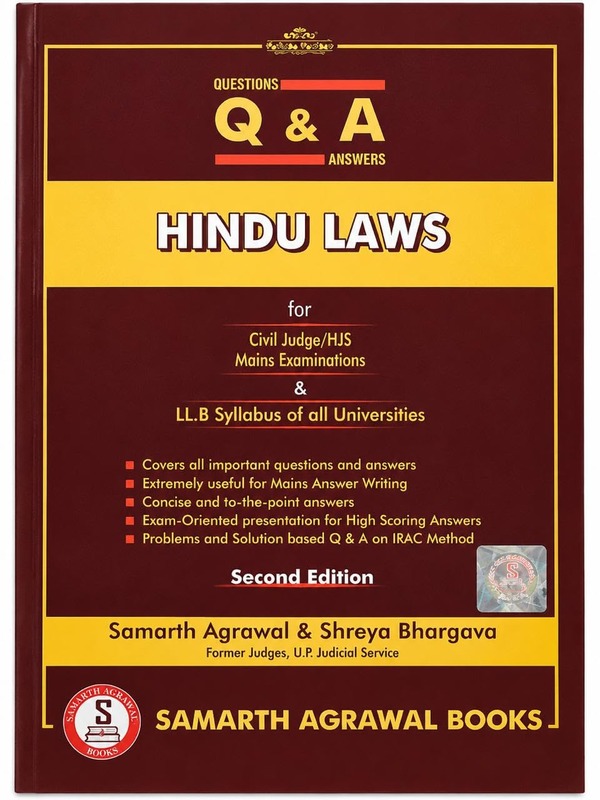
Samarth's Questions and Answers: Hindu Laws - 2nd Edition 2026
| Author : | SHREYA BHARGAVA, SAMARTH AGRAWAL |
|---|
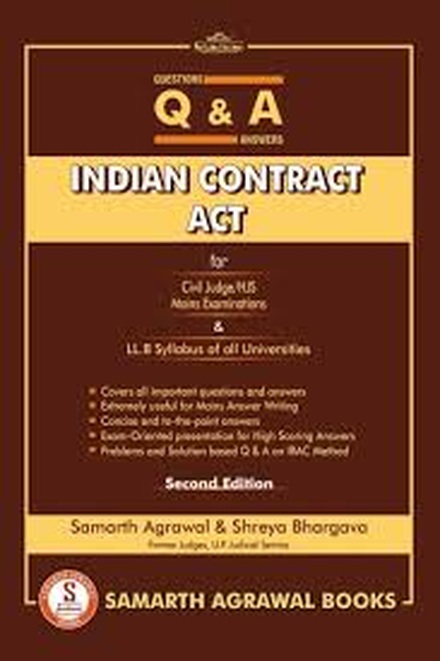
| Samarth's Questions and Answers: Hindu Laws, Second Edition, by Samarth Agrawal and Shreya Bhargava, both former Judges of the U.P. Judicial Service, presents Hindu law in question-and-answer form with full model answers and problem-and-solution questions worked on the IRAC method. It covers the sources of Hindu law and the Mitakshara and Dayabhaga schools, the joint Hindu family and coparcenary and the right by birth, the powers of the karta and alienation for legal necessity, benefit of the estate and antecedent debt, partition, reopening and reunion, the Hindu Marriage Act 1955 with the conditions of marriage, void and voidable marriages, restitution of conjugal rights, judicial separation and the grounds of divorce, the Hindu Succession Act 1956 with Class I and Class II heirs, section 14, succession to a female Hindu and the 2005 amendment making daughters coparceners, the Hindu Adoptions and Maintenance Act 1956, the Hindu Minority and Guardianship Act 1956, stridhan, and religious and charitable endowments. Paperback, English. |


Tags: All State Civil Judge Examination, Family Law, Hindu Law, All State Higher Judicial Service (Main)Exam
Samarth's Questions and Answers: Hindu Laws by Samarth Agrawal and Shreya Bhargava, both former Judges of the U.P. Judicial Service, published by Samarth Agrawal Books, is the Second Edition of a question-and-answer guide to Hindu law, written for the Civil Judge and Higher Judicial Service Mains examinations and for the LL.B. syllabus of all universities. Paperback, English.
Hindu law is examined in two registers at once. Half the paper asks for the classical learning — the sources, the Mitakshara and Dayabhaga schools, coparcenary, the powers of the karta, partition. The other half asks for the four codifying Acts of 1955 and 1956, and for the way the courts have read them since, above all the 2005 amendment that made daughters coparceners by birth. A candidate who is fluent in one register and shaky in the other loses marks in every paper.
This book is written to cover both, in the form the examination actually takes. Each likely question is answered in full, at the length a descriptive paper expects, and the volume also carries problem-and-solution questions worked on the IRAC method — Issue, Rule, Application, Conclusion — which is exactly the discipline a mains problem question rewards and the part most candidates have never been taught.
Key Features
- Second Edition, Samarth Agrawal Books
- Written by two former Judges of the U.P. Judicial Service
- Covers all important questions and answers on Hindu law
- Extremely useful for Mains answer writing
- Concise and to-the-point answers for quick revision
- Exam-oriented presentation aimed at high-scoring answers
- Problem-and-solution Q&A worked on the IRAC method
- For Civil Judge (PCS-J) and HJS Mains and the LL.B. syllabus of all universities
- Paperback · English
Coverage
Sources and Schools. The ancient and modern sources of Hindu law — Shruti, Smriti, commentaries and digests, custom, legislation and judicial precedent; the Mitakshara and Dayabhaga schools and their sub-schools; and the application of Hindu law — who is a Hindu.
Joint Hindu Family and Coparcenary. The composition of the joint family, the distinction between joint family and coparcenary, right by birth, joint family property and separate property, and the incidents of coparcenary.
Karta and Alienation. The position, powers and liabilities of the karta; alienation for legal necessity, benefit of the estate and antecedent debt; the son's pious obligation; and the remedies of a coparcener against an improper alienation.
Partition. The meaning of partition, property that is and is not divisible, persons entitled to a share, modes of effecting partition, reopening of partition and reunion.
Hindu Marriage Act, 1955. Conditions of a valid marriage, sapinda and prohibited degrees, registration, void and voidable marriages and the status of children of such marriages, restitution of conjugal rights, judicial separation, the grounds of divorce including cruelty, desertion and irretrievable breakdown as argued, divorce by mutual consent, bars to relief, and maintenance pendente lite and permanent alimony.
Hindu Succession Act, 1956. Intestate succession to the property of a male Hindu — Class I and Class II heirs, agnates and cognates; succession to the property of a female Hindu and section 15; section 14 and the conversion of a limited estate into full ownership; the 2005 amendment making daughters coparceners; and disqualifications from inheritance.
Hindu Adoptions and Maintenance Act, 1956. The requisites of a valid adoption, who may take and give in adoption, the effects of adoption and the doctrine of relation back; and maintenance of wife, widowed daughter-in-law, children, aged parents and dependants.
Hindu Minority and Guardianship Act, 1956. Natural, testamentary and de facto guardians, their powers over the minor's property, and the welfare of the minor as the paramount consideration.
Stridhan and Women's Property. The concept of stridhan, the woman's estate, and the present position of a Hindu woman's property rights.
Religious and Charitable Endowments. Math and debutter property, the position of the shebait and the mahant, and the law of religious endowments.
Who Should Buy This Book?
- Civil Judge (PCS-J) aspirants preparing the personal law paper for Mains
- Higher Judicial Service (HJS) candidates
- LL.B. and B.A. LL.B. students taking Hindu Law / Family Law, at any university
- Advocates practising in matrimonial, succession and partition matters
- Candidates for APO and other examinations with a family law component
- Repeat candidates working on answer presentation and problem questions
- Judiciary coaching institutes and their faculty
- Law college and coaching-centre libraries
Why Choose This Book?
The distinctive feature is the IRAC treatment of problem questions. Hindu law papers lean heavily on hypotheticals — a partition between named parties, a succession on an intestacy, a disputed adoption — and candidates who can recite the law still lose marks because they narrate instead of analysing. Worked solutions that identify the issue, state the rule, apply it and conclude teach a method that transfers to every other paper.
The second reason is that it holds both halves of the subject together. Classical coparcenary doctrine and the codified Acts are examined in the same paper, and a book that moves between them as the examination does is more useful than a textbook organised by statute alone.
The third is the authorship. Both authors served as judges in the U.P. Judicial Service, where succession and matrimonial matters are daily work. The selection of questions reflects what a court — and an examiner — actually treats as important.