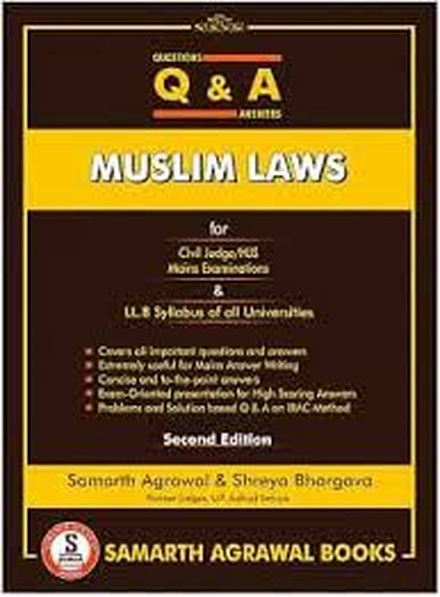
Samarth's Questions and Answers: Muslim Laws - 2nd Edition 2026
| Author : | SHREYA BHARGAVA, SAMARTH AGRAWAL |
|---|
| Samarth's Questions and Answers: Muslim Laws, Second Edition, by Samarth Agrawal and Shreya Bhargava, both former Judges of the U.P. Judicial Service, presents Muslim personal law in question-and-answer form with full model answers and problem-and-solution questions worked on the IRAC method. It covers the sources of Muslim law and the Sunni and Shia schools, nikah and the essentials of a valid marriage with void, irregular and muta marriages, dower and the widow's right of retention, talaq in its forms and the position after the Muslim Women (Protection of Rights on Marriage) Act 2019, khula, mubarat and lian, dissolution under the Dissolution of Muslim Marriages Act 1939, iddat, maintenance and the 1986 Act, acknowledgement of paternity, guardianship and hizanat, hiba and the doctrine of musha, wills and the one-third rule, waqf and the mutawalli, the Sunni and Shia schemes of inheritance with aul and radd, and pre-emption. Paperback, English. |


Tags: All State Civil Judge Examination, Family Law, Muslim Law, All State Higher Judicial Service (Main)Exam
Samarth's Questions and Answers: Muslim Laws by Samarth Agrawal and Shreya Bhargava, both former Judges of the U.P. Judicial Service, published by Samarth Agrawal Books, is the Second Edition of a question-and-answer guide to Muslim personal law, written for the Civil Judge and Higher Judicial Service Mains examinations and for the LL.B. syllabus of all universities. Paperback, English.
Muslim law is the paper candidates most often leave until last, and it punishes that. The subject is largely uncodified, the terminology is unfamiliar, and the schools differ on points the examiner will ask about — the Hanafi and Shia positions on the revocation of talaq, on the validity of a will beyond one-third, on inheritance shares. A vague answer that gestures at "Muslim law" without naming the school earns little. The marks go to candidates who state the rule, identify whose rule it is, and apply it.
This book is written for exactly that. The questions the commissions set are answered in full, in the structure and at the length a descriptive paper expects, and the volume carries problem-and-solution questions worked on the IRAC method — Issue, Rule, Application, Conclusion — which is how the inheritance and talaq hypotheticals in this paper are meant to be answered.
Key Features
- Second Edition, Samarth Agrawal Books
- Written by two former Judges of the U.P. Judicial Service
- Covers all important questions and answers on Muslim personal law
- Extremely useful for Mains answer writing
- Concise and to-the-point answers for quick revision
- Exam-oriented presentation aimed at high-scoring answers
- Problem-and-solution Q&A worked on the IRAC method
- For Civil Judge (PCS-J) and HJS Mains and the LL.B. syllabus of all universities
- Paperback · English
Coverage
Origin, Sources and Schools. The sources of Muslim law — the Quran, Sunna, Ijma and Qiyas — and the secondary sources; the Sunni and Shia schools and their sub-schools; and the application of Muslim law in India.
Marriage (Nikah). The nature of nikah as a civil contract, the essentials of a valid marriage, capacity and consent, void (batil), irregular (fasid) and valid marriages and the differences between the schools, muta marriage, and the legal effects of marriage.
Dower (Mahr). The nature and object of dower, prompt and deferred dower, specified and proper dower, the widow's right of retention, and the remedies for recovery.
Dissolution of Marriage. Talaq and its forms — talaq-e-ahsan, hasan and the position of triple talaq after the Muslim Women (Protection of Rights on Marriage) Act, 2019; talaq-e-tafweez, khula and mubarat, ila, zihar and lian; dissolution under the Dissolution of Muslim Marriages Act, 1939; and the effects of dissolution.
Iddat. The periods of iddat on divorce and on death, and the legal consequences during iddat.
Maintenance. The wife's right to maintenance, maintenance of children and relatives, the Muslim Women (Protection of Rights on Divorce) Act, 1986, and the interaction with the general law of maintenance.
Legitimacy and Acknowledgement. The presumption of legitimacy and the doctrine of acknowledgement of paternity.
Guardianship and Custody. Guardianship of the person and of property, the de facto and certificated guardian, and hizanat — the mother's right of custody and its duration under the different schools.
Gift (Hiba). The essentials of a valid hiba — declaration, acceptance and delivery of possession; gift of musha; conditional and contingent gifts; hiba-bil-iwaz and hiba-ba-shart-ul-iwaz; and the revocation of gifts.
Wills (Wasiyat). Capacity to make a will, the one-third rule and the requirement of heirs' consent, bequests to an heir, and revocation and abatement of legacies.
Waqf. The definition and essentials of waqf, its kinds including waqf-alal-aulad, the mutawalli and his powers and removal, and the statutory framework governing waqfs.
Inheritance. The general principles of Muslim succession, the Sunni scheme of sharers, residuaries and distant kindred, the doctrines of aul and radd, the Shia scheme of heirs by consanguinity and by marriage, exclusion from inheritance, and the distribution of the estate.
Pre-emption (Shufa). The right of pre-emption, who may claim it, the formalities required, and the grounds on which it is lost.
Who Should Buy This Book?
- Civil Judge (PCS-J) aspirants preparing the personal law paper for Mains
- Higher Judicial Service (HJS) candidates
- LL.B. and B.A. LL.B. students taking Muslim Law / Family Law, at any university
- Advocates practising in matrimonial, maintenance, waqf and succession matters
- Candidates for APO and other examinations with a family law component
- Repeat candidates working on answer presentation and problem questions
- Judiciary coaching institutes and their faculty
- Law college and coaching-centre libraries
Why Choose This Book?
The first reason is that it treats the schools as part of the answer. Muslim law questions turn on the Sunni–Shia divergence far more often than candidates expect, and model answers that name the school each time build a habit that a general textbook does not.
The second is the IRAC problem solutions. Inheritance questions in this paper are arithmetic as much as doctrine — a named set of survivors, shares to be computed, aul or radd to be applied. Worked solutions that identify the issue, state the rule, apply it and conclude are far more use than a narrative explanation of the rules.
The third is proportion. This is the shortest paper on the syllabus for most universities and commissions, and a compact Q&A volume is the right instrument for it — enough to secure the marks without the time cost of a full treatise.