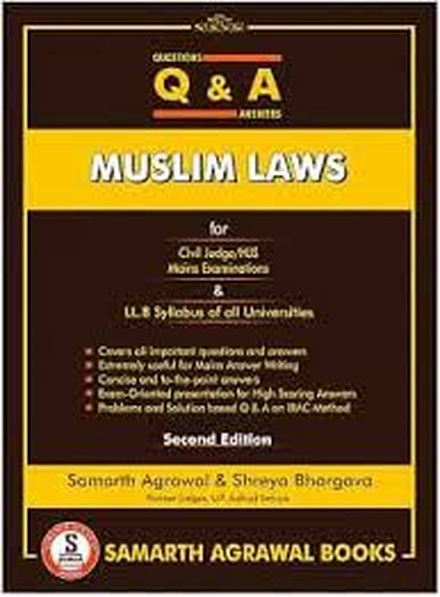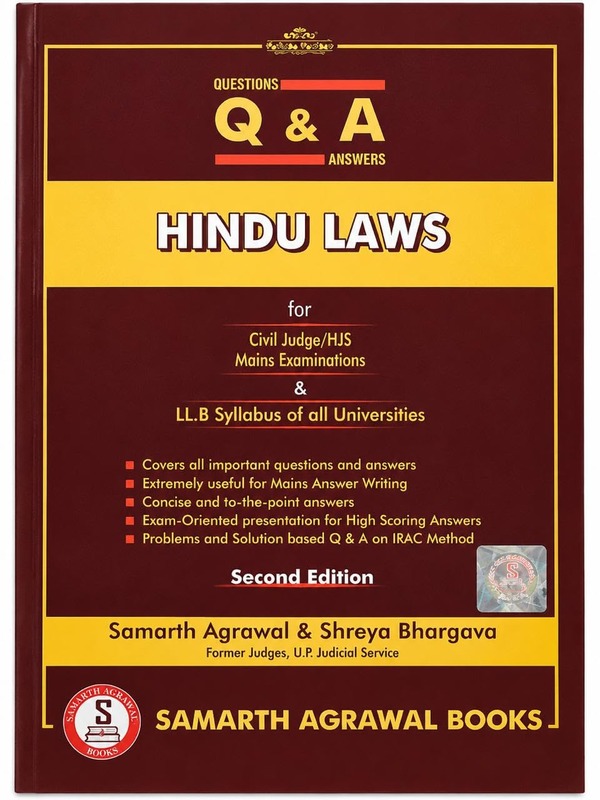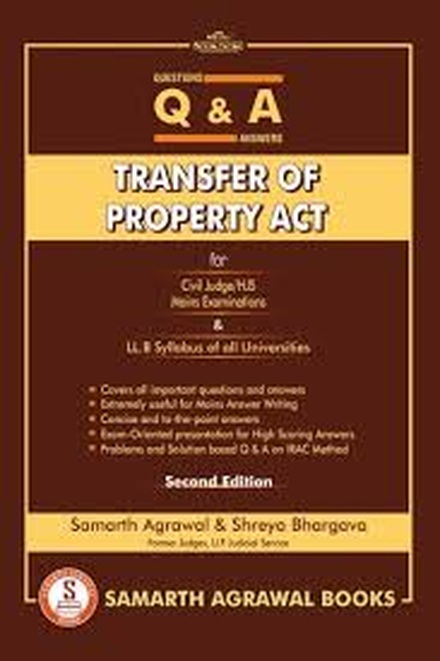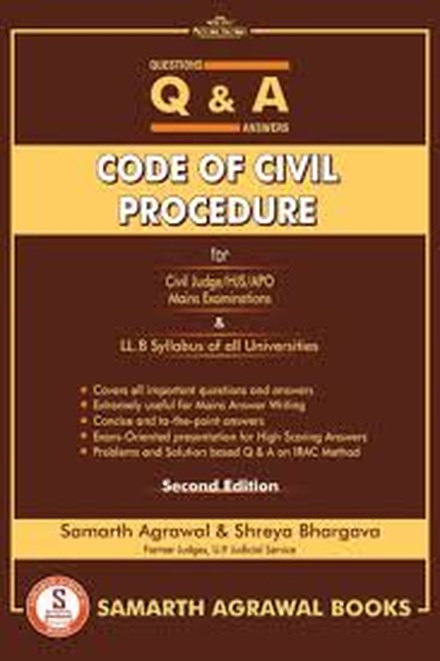
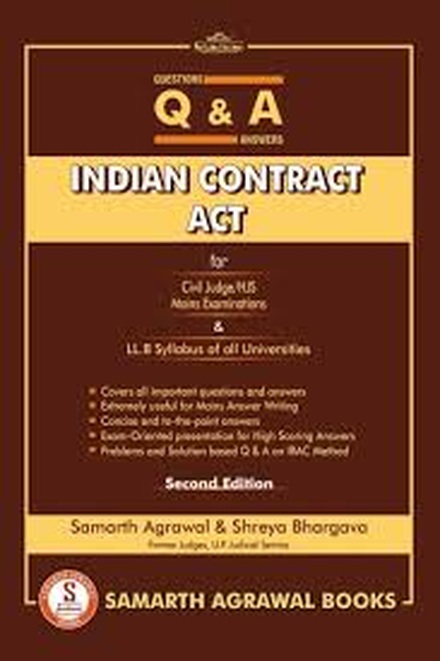
Samarth's Questions and Answers: Indian Contract Act - 2nd Edition 2026
| Author : | SHREYA BHARGAVA, SAMARTH AGRAWAL |
|---|
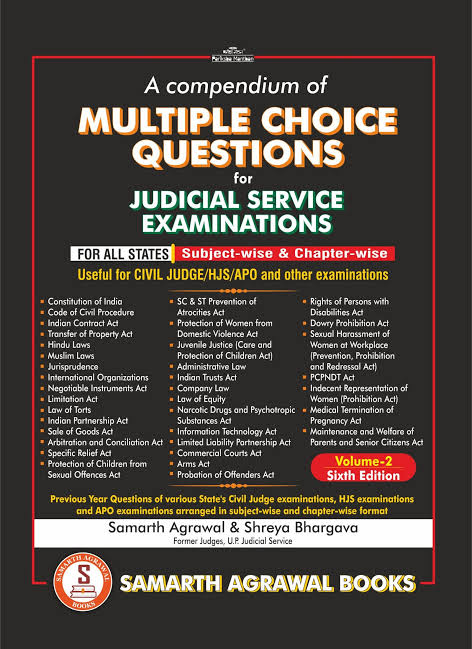
| Samarth's Questions and Answers: Indian Contract Act, Second Edition, by Samarth Agrawal and Shreya Bhargava, both former Judges of the U.P. Judicial Service, presents the Indian Contract Act, 1872 in question-and-answer form with model answers written to the structure and length a descriptive paper expects. It covers proposal and acceptance and the rules of communication and revocation, consideration and privity with the section 25 exceptions, capacity and minors' agreements, free consent through coercion, undue influence, fraud, misrepresentation and mistake, unlawful object and agreements against public policy, restraint of trade and wagering agreements, contingent contracts, performance, reciprocal promises and discharge by novation and otherwise, frustration under section 56, anticipatory breach and damages under sections 73 and 74, quasi-contracts, indemnity and guarantee and the discharge of a surety, bailment, lien and pledge, and the law of agency. 280 pages, paperback, English. |


Tags: All State Civil Judge Examination, Contract Law, All State Higher Judicial Service (Main)Exam, Law of Contract & Specific Relief
Samarth's Questions and Answers: Indian Contract Act by Samarth Agrawal and Shreya Bhargava, both former Judges of the U.P. Judicial Service, published by Samarth Agrawal Books, is the Second Edition of a question-and-answer guide to the Indian Contract Act, 1872, written for the Civil Judge and Higher Judicial Service Mains examinations and for the LL.B. syllabus of all universities. 280 pages, paperback, English.
A judicial mains paper is not a test of whether a candidate knows the law. Everyone in the hall knows it. It is a test of whether they can set it down in twenty minutes in the shape an examiner rewards — the issue identified, the section stated, the leading case named, the principle applied to the facts, a conclusion. Candidates lose marks they have already earned because nobody showed them what a full-mark answer looks like.
That is the gap this book fills. Every important question on the Contract Act that a commission is likely to set is answered in full, in the structure and at the length the mains paper expects. Because the authors sat on the Bench of the U.P. Judicial Service themselves, the model answers reflect what an examiner actually looks for rather than what a textbook would say at leisure.
Key Features
- Second Edition, Samarth Agrawal Books
- Written by two former Judges of the U.P. Judicial Service
- Question-and-answer format throughout, with model answers
- Built for Civil Judge (PCS-J) and HJS Mains descriptive papers
- Matched to the LL.B. syllabus of all universities
- Concise, exam-oriented answers suitable for quick revision
- Trains answer-writing technique, not merely subject knowledge
- 280 pages · Paperback · English
Coverage
Formation of Contract. Proposal and acceptance, communication, revocation and lapse, the distinction between an offer and an invitation to treat, standing offers, and the rules on communication by post and by electronic means.
Consideration. The definition and essentials of consideration, past, executed and executory consideration, privity of contract and privity of consideration, and the exceptions under section 25 where an agreement without consideration is valid.
Capacity to Contract. Minors' agreements and the rule in Mohori Bibee, restitution and necessaries, persons of unsound mind, and disqualification by law.
Free Consent. Coercion, undue influence, fraud, misrepresentation and mistake — their definitions, the distinctions between them, the effect of each on the contract, and the remedies available.
Legality of Object and Void Agreements. Unlawful consideration and object, agreements opposed to public policy, agreements in restraint of marriage, of trade and of legal proceedings, wagering agreements, and agreements void for uncertainty.
Contingent Contracts. The nature of a contingent contract, the rules governing its enforcement, and its distinction from a wagering agreement.
Performance and Discharge. Who must perform, time and place of performance, reciprocal promises, appropriation of payments, assignment, and discharge by performance, agreement, novation, rescission, alteration and operation of law.
Frustration and Impossibility. Section 56 and the doctrine of frustration, supervening impossibility, the English doctrine compared, and the consequences of frustration.
Breach and Remedies. Anticipatory and actual breach, damages under section 73 and the rule in Hadley v. Baxendale, remoteness and measure of damages, liquidated damages and penalty under section 74, and quantum meruit.
Quasi-Contracts. The certain relations resembling those created by contract — supply of necessaries, payment by an interested person, benefit of a non-gratuitous act, finder of goods and money paid by mistake or under coercion.
Indemnity and Guarantee. The contract of indemnity and the rights of the indemnity-holder; the contract of guarantee, the surety's liability, continuing guarantee and its revocation, and the discharge of the surety.
Bailment and Pledge. The essentials of bailment, the duties and rights of bailor and bailee, lien, finder of goods, and pledge — pledge by a person in possession under a voidable contract and by a mercantile agent.
Agency. Creation of agency, agency by ratification and by estoppel, the authority of an agent and agency of necessity, sub-agents and substituted agents, the relations between principal, agent and third parties, undisclosed principals, and the termination of agency.
Who Should Buy This Book?
- Civil Judge (PCS-J) aspirants preparing for the Mains descriptive papers
- Higher Judicial Service (HJS) candidates
- APO and public prosecutor aspirants
- LL.B. and B.A. LL.B. students taking the Law of Contract paper, at any university
- Repeat candidates working specifically on answer presentation
- Judiciary coaching institutes and their faculty
- Students revising shortly before an examination
- Law college and coaching-centre libraries
Why Choose This Book?
The honest case for a Q&A volume is that a mains candidate's weakest skill is usually writing, not knowing. Reading a treatise on the Contract Act teaches the law; reading thirty model answers teaches the discipline of stating it under time. Those are different exercises, and only one of them is examined.
The second reason is the authorship. Both authors served as judges in the U.P. Judicial Service before writing. They have seen what distinguishes a scripted answer from a good one, and the selection of questions reflects that rather than a textbook's table of contents.
The third is double duty. The same volume serves the LL.B. Contract paper and the judiciary mains, so a student who buys it in the first year is still using it when they sit the examination — which is unusual for exam-oriented books and makes it unusually good value.