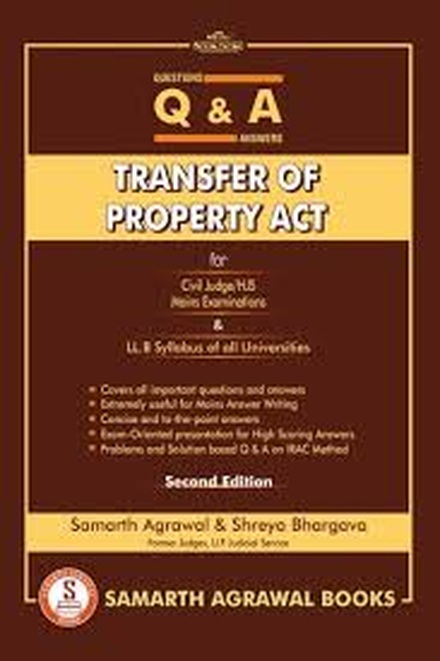
Samarth's Questions and Answers: Transfer of Property Act - 2nd Edition 2026
| Author : | SHREYA BHARGAVA, SAMARTH AGRAWAL |
|---|
| Samarth's Questions and Answers: Transfer of Property Act, Second Edition, by Samarth Agrawal and Shreya Bhargava, both former Judges of the U.P. Judicial Service, presents the Transfer of Property Act, 1882 in question-and-answer form with full model answers written to the structure a descriptive paper requires. It covers immovable property, attestation and notice, what may be transferred under section 6 and spes successionis, conditional transfers, vested and contingent interests, transfer to an unborn person and the rule against perpetuity, lis pendens under section 52, fraudulent transfer under section 53 and part performance under section 53-A, the doctrines of election and of feeding the grant by estoppel, transfer by an ostensible owner under section 41, sale of immovable property and the charge for unpaid purchase money, the six kinds of mortgage under section 58 with redemption, clogs, foreclosure, priority, subrogation, marshalling and contribution, charges, leases and their determination, forfeiture and holding over, exchange, gift and onerous gifts, and the transfer of actionable claims. Paperback, English. |


Tags: All State Civil Judge Examination, Property Law, Transfer of Property Act, All State Higher Judicial Service (Main)Exam
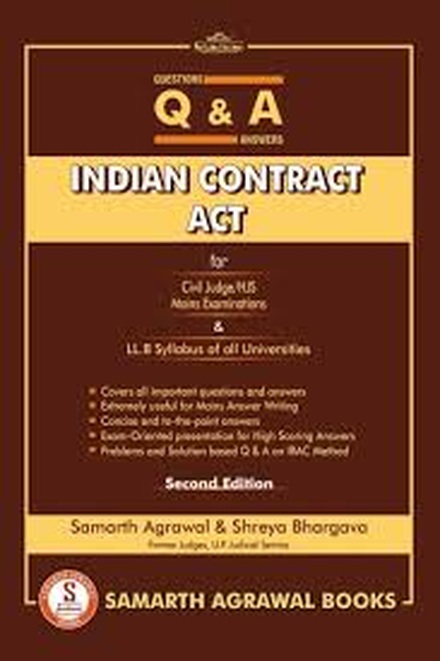
Samarth's Questions and Answers: Transfer of Property Act by Samarth Agrawal and Shreya Bhargava, both former Judges of the U.P. Judicial Service, published by Samarth Agrawal Books, is the Second Edition of a question-and-answer guide to the Transfer of Property Act, 1882, written for the Civil Judge and Higher Judicial Service Mains examinations and for the LL.B. syllabus of all universities. Paperback, English.
The Transfer of Property Act is a drafting statute disguised as a textbook subject. Its doctrines — lis pendens, part performance, the rule against perpetuity, the doctrine of election, marshalling and contribution — are each compact, heavily litigated, and almost impossible to state correctly from memory without having written them out before. A mains answer on section 53-A that omits the five conditions earns a fraction of the marks, and a candidate rarely discovers which condition they drop until the paper comes back.
This book is designed to close that gap. The questions the commissions actually set are answered in full, with the section stated and the leading authority named, in the structure and at the length a descriptive paper expects. The authors served as judges in the U.P. Judicial Service, so the model answers reflect what an examiner rewards rather than what a commentary would say at leisure.
Key Features
- Second Edition, Samarth Agrawal Books
- Written by two former Judges of the U.P. Judicial Service
- Question-and-answer format with full model answers
- For Civil Judge (PCS-J) and HJS Mains descriptive papers
- Matched to the LL.B. syllabus of all universities
- Exact statement of sections and conditions, which this subject rewards
- Concise enough for last-stage revision
- Paperback · English
Coverage
Preliminary and Definitions. The scope of the Act, immovable property, attestation, notice — actual, constructive and imputed — and the distinction between movable and immovable property.
Transfer of Property: General Principles. What may be transferred under section 6 and the excepted interests, including spes successionis; persons competent to transfer; the mode of transfer and the requirement of writing and registration; and oral transfers.
Conditions and Restrictions. Conditional transfers, condition precedent and subsequent, the rule against perpetuity under section 14, transfer to an unborn person under section 13, accumulation of income, vested and contingent interests, and conditions restraining alienation and enjoyment.
Doctrines of the Act. Lis pendens (section 52), fraudulent transfer (section 53), part performance (section 53-A) and its conditions, the doctrine of election (section 35), feeding the grant by estoppel (section 43), and the transfer by an ostensible owner under section 41.
Sale of Immovable Property. Sale and contract for sale under section 54, the rights and liabilities of buyer and seller, the charge for unpaid purchase money, and marshalling by a subsequent purchaser.
Mortgages. The definition of mortgage and the six kinds under section 58 — simple, conditional sale, usufructuary, English, mortgage by deposit of title deeds and anomalous; redemption and the rule against clogs; foreclosure and sale; priority of mortgages and tacking; subrogation, marshalling and contribution; and the rights and liabilities of mortgagor and mortgagee.
Charges. The nature of a charge and its distinction from a mortgage.
Leases. The definition of a lease under section 105 and its distinction from a licence, the duration and formalities, the rights and liabilities of lessor and lessee, determination of lease under section 111, forfeiture and waiver, and holding over under section 116.
Exchange and Gift. Exchange of property; the essentials of a gift under section 122, acceptance and delivery, onerous gifts, and the suspension or revocation of a gift.
Transfer of Actionable Claims. The meaning of an actionable claim and the mode and effect of its transfer.
Who Should Buy This Book?
- Civil Judge (PCS-J) aspirants preparing the property paper for Mains
- Higher Judicial Service (HJS) candidates
- LL.B. and B.A. LL.B. students taking Transfer of Property / Property Law, at any university
- Juniors in civil and property practice who want the doctrines stated precisely
- Candidates for APO and other competitive examinations with a property paper
- Repeat candidates working on answer presentation
- Judiciary coaching institutes and their faculty
- Law college and coaching-centre libraries
Why Choose This Book?
The Transfer of Property Act is a conditions subject. Section 53-A has five, section 41 has four, the rule against perpetuity turns on a precise formulation — and marks are lost by omission, not by misunderstanding. Model answers that set those conditions out every time build the habit of completeness far better than reading a commentary does.
The second reason is selection. The commissions return to the same doctrines year after year: lis pendens, part performance, ostensible owner, redemption and clogs, lease versus licence. Two former judges choosing the questions is worth more than an exhaustive list no candidate can revise in the final week.
The third is double duty. The same volume covers the university property paper and the judiciary mains, so a student who buys it early is still using it when they sit the examination.