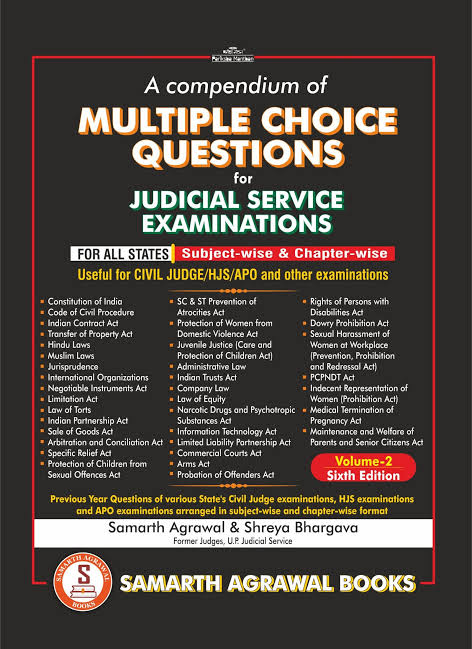
Samarth's Questions and Answers: Code of Civil Procedure - 2nd Edition 2026
| Author : | SHREYA BHARGAVA, SAMARTH AGRAWAL |
|---|
| Samarth's Questions and Answers: Code of Civil Procedure, Second Edition, by Samarth Agrawal and Shreya Bhargava, both former Judges of the U.P. Judicial Service, presents the Code of Civil Procedure, 1908 in question-and-answer form with full model answers citing the section or Order and Rule precisely, as a descriptive paper requires. It covers decree, order and judgment and foreign judgments, res judicata under section 11 and stay under section 10, place of suing and transfer of suits, joinder of parties and representative suits, pleadings and their amendment under Order VI Rule 17, rejection of the plaint under Order VII Rule 11, written statement, set-off and counter-claim, ex parte proceedings and Order IX, temporary injunctions, attachment before judgment and receivers, framing of issues, judgment, decree and mesne profits, first and second appeals, reference, review and revision, execution under Order XXI, indigent persons, summary suits under Order XXXVII, caveat under section 148-A and inherent powers under section 151. 275 pages, paperback, English. |


Tags: APO Exam, All State Civil Judge Examination, Code Of Civil Procedure, All State Higher Judicial Service (Main)Exam
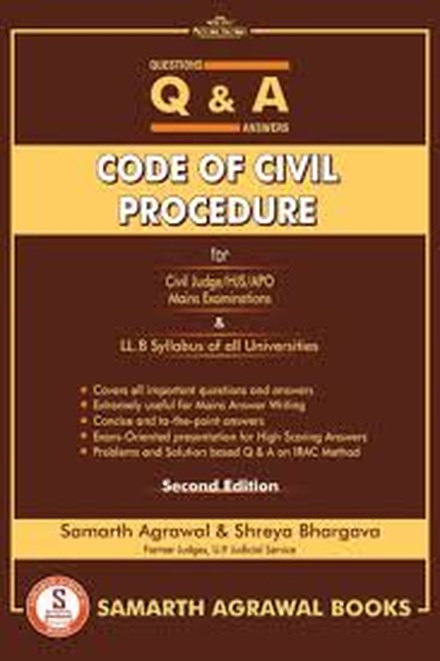
Samarth's Questions and Answers: Code of Civil Procedure by Samarth Agrawal and Shreya Bhargava, both former Judges of the U.P. Judicial Service, published by Samarth Agrawal Books, is the Second Edition of a question-and-answer guide to the Code of Civil Procedure, 1908, written for the Civil Judge, HJS and APO Mains examinations and for the LL.B. syllabus of all universities. 275 pages, paperback, English.
The Code of Civil Procedure is the hardest paper in the mains to write well, and the easiest to half-know. Its difficulty is not conceptual; it is that the answers live in a mesh of sections, Orders and Rules that have to be cited precisely. "A suit may be dismissed for default" earns nothing. Order IX Rule 8, the remedy under Order IX Rule 9, and the distinction from an ex parte decree under Order IX Rule 13 earns the mark. Examiners know within two lines whether a candidate has the Code at their fingertips.
This book is built for that. Each likely question is answered in full, with the section or Order and Rule stated where it belongs, in the structure and at the length a descriptive paper expects. The authors sat as judges in the U.P. Judicial Service — they have read these answer scripts from the other side, and the models reflect what actually scores.
Key Features
- Second Edition, Samarth Agrawal Books
- Written by two former Judges of the U.P. Judicial Service
- Question-and-answer format with full model answers
- For Civil Judge (PCS-J), HJS and APO Mains descriptive papers
- Matched to the LL.B. syllabus of all universities
- Precise citation of sections, Orders and Rules throughout
- Concise enough for last-stage revision
- 275 pages · Paperback · English
Coverage
Preliminary and Jurisdiction. The scheme of the Code, the distinction between sections and the Rules in the Schedule, decree, order and judgment, foreign judgment and section 13, and the bar of suits.
Res Judicata and Res Sub Judice. Section 11 and the conditions of res judicata, constructive res judicata, and the stay of suit under section 10.
Place of Suing and Transfer. Sections 15 to 20, objections to jurisdiction, and the transfer of suits under sections 22 to 25.
Institution of Suits and Parties. Institution of a suit, joinder and misjoinder of parties and causes of action, necessary and proper parties, representative suits under Order I Rule 8, and suits by or against the Government under section 80.
Pleadings. Fundamental rules of pleading, particulars, amendment of pleadings under Order VI Rule 17, the plaint and its rejection under Order VII Rule 11, the written statement, set-off and counter-claim.
Summons and Appearance. Issue and service of summons, ex parte proceedings, dismissal for default under Order IX, and the setting aside of dismissal and of an ex parte decree.
Interlocutory Proceedings. Temporary injunctions under Order XXXIX and the three tests, attachment before judgment and arrest before judgment under Order XXXVIII, receivers under Order XL, and commissions under Order XXVI.
Discovery, Issues and Trial. Discovery, inspection and admissions, framing of issues under Order XIV, summoning and examination of witnesses, adjournments, and the hearing of the suit.
Judgment and Decree. Judgment and decree, mesne profits, interest under section 34, costs, and the preliminary and final decree.
Appeals, Reference, Review and Revision. First appeal and second appeal under section 100 with the substantial question of law, appeal from orders, reference, review and revision under sections 113, 114 and 115, and the Letters Patent appeal.
Execution. The decree-holder and judgment-debtor, the court executing a decree and transfer for execution, modes of execution, attachment and sale, arrest and detention, objections and Order XXI Rule 97 to 106, and the determination of questions under section 47.
Special Suits and Proceedings. Suits by indigent persons under Order XXXIII, interpleader suits, suits by or against minors, summary procedure under Order XXXVII, and caveat under section 148-A.
Inherent Powers and Allied Matters. Section 151 and the inherent powers of the court, withdrawal and compromise of suits under Order XXIII, and limitation as it bears on civil proceedings.
Who Should Buy This Book?
- Civil Judge (PCS-J) aspirants preparing the CPC paper for Mains
- Higher Judicial Service (HJS) candidates
- APO and Assistant Prosecution Officer aspirants
- LL.B. and B.A. LL.B. students taking Civil Procedure, at any university
- Juniors in civil practice who want the Orders and Rules straight
- Repeat candidates working on answer presentation rather than fresh reading
- Judiciary coaching institutes and their faculty
- Law college and coaching-centre libraries
Why Choose This Book?
The case for a Q&A volume is strongest in exactly this subject. The CPC rewards precision of citation more than any other paper, and precision is a habit built by writing, not by reading. Working through model answers that name the Order and Rule each time trains the reflex that the examination tests.
The second reason is selection. The Code is vast and the commissions return to a predictable core — res judicata, Order VII Rule 11, Order IX, temporary injunctions, section 100, execution under Order XXI, section 151. Having two former judges choose the questions is worth more than an exhaustive list nobody can revise.
The third is that it does double duty. The same book carries a student through the university CPC paper and then through the judiciary mains years later, which is unusual for an exam-oriented title.