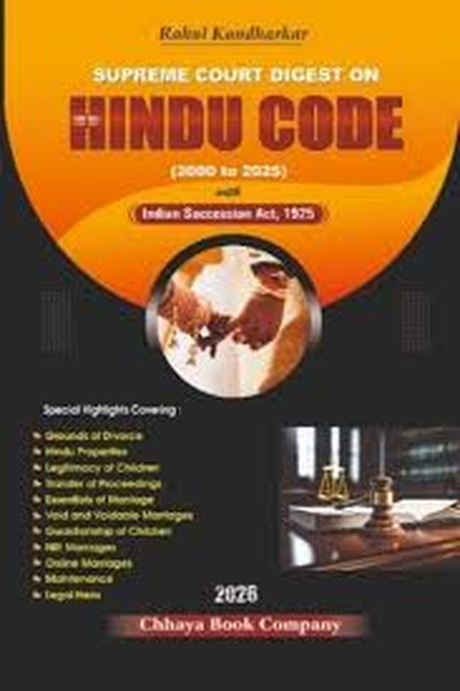
Chhaya's Supreme Court Digest on Hindu Code (2000 to 2025) with Indian Succession Act, 1925 - 1st Edition 2026
| Author : | Rahul Kandharkar |
|---|
| A twenty-five year digest of Supreme Court judgments on the Hindu Code, arranged issue-wise and bound in one hardcover volume. Rahul Kandharkar covers the essentials of a valid Hindu marriage, void and voidable marriages, every ground of divorce including cruelty, desertion and irretrievable breakdown, divorce by mutual consent under Section 13-B, maintenance under the Hindu Marriage Act and the Hindu Adoptions and Maintenance Act, Hindu properties and coparcenary rights after the 2005 succession amendment, legitimacy of children under Section 16, guardianship and custody on the welfare principle, adoption, and transfer of matrimonial proceedings. Separate treatment is given to NRI marriages and online marriages, and the Indian Succession Act, 1925 is covered alongside — wills, probate, letters of administration and intestate succession — so both succession regimes sit in the same book. 1st Edition 2026, Chhaya Book Company. |


Tags: Hindu Law, Supreme Court, Case Digest, The Indian Succession Act
Supreme Court Digest on Hindu Code (2000 to 2025) with Indian Succession Act, 1925 by Rahul Kandharkar, published by Chhaya Book Company, brings a quarter-century of Supreme Court decisions on Hindu personal law together in a single hardbound reference. First Edition, 2026.
The four Hindu Code statutes — the Hindu Marriage Act, 1955, the Hindu Succession Act, 1956, the Hindu Minority and Guardianship Act, 1956 and the Hindu Adoptions and Maintenance Act, 1956 — are compact pieces of drafting that now carry an enormous weight of judicial interpretation. What counts as cruelty, when desertion is complete, whether a marriage is void or merely voidable, how a daughter's coparcenary right operates after the 2005 amendment and after Vineeta Sharma, where a transfer petition will be allowed, what a court will do about a marriage solemnised abroad or conducted online — none of this is answered by reading the sections alone. It is answered by the line of Supreme Court authority that has built up around them. This digest collects that authority and arranges it so a family court practitioner can find the controlling case in minutes rather than hours.
Rahul Kandharkar is a familiar name in digest work, with volumes on the law of maintenance, labour law and human rights behind him. The format here is the one his readers expect: case law organised by issue, stated tightly, and usable at the counter.
Key Features
- Supreme Court judgments from 2000 to 2025 — a full twenty-five year span of Hindu personal law jurisprudence in one volume.
- Covers the whole Hindu Code: marriage, divorce, succession, guardianship, adoption and maintenance.
- The Indian Succession Act, 1925 included, so testamentary and intestate succession outside the Hindu Succession Act is covered in the same book — useful in wills, probate and letters of administration matters.
- Issue-wise arrangement rather than chronological listing, so research starts from the question actually before the court.
- Dedicated treatment of modern problems — NRI marriages and online marriages — where the older textbooks are silent.
- Transfer of proceedings covered as a subject in its own right, reflecting how large a share of the Supreme Court's matrimonial docket transfer petitions occupy.
- Hardbound, 1st Edition 2026 — current through 2025 decisions.
- Written by Rahul Kandharkar, author of digests on maintenance law, labour law and human rights.
Coverage
- Essentials of a valid Hindu marriage: the conditions under Section 5, ceremonies under Section 7, proof of solemnisation, and the consequences of non-compliance.
- Void and voidable marriages: the distinction under Sections 11 and 12, bigamy, impotence, fraud and concealment, force and consent, and the status of parties to a void union.
- Grounds of divorce: cruelty — mental and physical, desertion, adultery, conversion, unsoundness of mind, venereal disease and renunciation, together with the evolving treatment of irretrievable breakdown and the exercise of power under Article 142.
- Divorce by mutual consent: Section 13-B, the waiting period and its waiver, withdrawal of consent, and the enforceability of settlement terms.
- Restitution of conjugal rights and judicial separation, and the relationship between those remedies and a later divorce petition.
- Maintenance: Section 24 and Section 25 of the Hindu Marriage Act, the Hindu Adoptions and Maintenance Act, 1956, maintenance pendente lite, quantum, interplay with Section 125 BNSS/CrPC and with the Domestic Violence Act.
- Hindu properties and succession: coparcenary and the Hindu Succession (Amendment) Act, 2005, the daughter's right and its retrospective operation, partition, self-acquired and ancestral property, and devolution under Sections 8, 15 and 16.
- Indian Succession Act, 1925: wills and their execution and attestation, probate and letters of administration, intestate succession for persons outside the Hindu Code, and succession certificates.
- Legitimacy of children: Section 16 of the Hindu Marriage Act, the rights of children of void and voidable marriages, and their claim to property.
- Guardianship and custody of children: the welfare principle as the paramount consideration, natural guardianship, visitation, removal of a child from the jurisdiction, and the role of the Guardians and Wards Act, 1890.
- Adoption: requirements for a valid adoption, the effect of adoption on succession rights, and proof of the adoption deed.
- Transfer of proceedings: the principles the Supreme Court applies to transfer petitions in matrimonial matters, including the convenience of the wife and the use of video-conferencing.
- NRI marriages: jurisdiction, foreign decrees of divorce and their recognition in India, and enforcement problems where one spouse is abroad.
- Online and remote marriages: the emerging questions on validity, proof and registration.
- Rights of legal heirs and connected procedural issues arising in matrimonial and succession litigation.
Who Should Buy This Book?
- Family law advocates practising before Family Courts, District Courts and High Courts.
- Judges and judicial officers of the Family Courts and civil courts deciding matrimonial, succession and guardianship matters.
- Advocates handling succession, partition and probate work, who need the Hindu Succession Act and the Indian Succession Act authorities together.
- Judicial service aspirants preparing for Civil Judge and Higher Judicial Service examinations, where Hindu law carries substantial marks.
- Mediators and counsellors attached to Family Courts and Lok Adalats.
- LL.B. and LL.M. students of Family Law and Personal Laws needing the current case position, not just the textbook statement.
- Law libraries, bar associations and Family Court libraries building a current personal-law reference.
Why Choose This Book?
Hindu law is one of those subjects where the gap between the bare Act and the law as applied is widest. A digest is the honest answer to that problem: it does not paraphrase the Supreme Court, it points you at what the Court actually held, issue by issue. Twenty-five years is a well-chosen window — long enough to include the whole arc of the 2005 succession amendment and the cruelty and irretrievable-breakdown jurisprudence, recent enough that the reader is not wading through authorities that have since been overtaken.
Two things set this volume apart from the general run of family law digests. The first is the inclusion of the Indian Succession Act, 1925, which matters because succession disputes rarely arrive neatly sorted by the parties' religion and a practitioner is usually better served by having both regimes to hand. The second is that it addresses NRI marriages and online marriages as subjects in their own right — questions that come up constantly in practice now and that most existing titles still treat as footnotes.