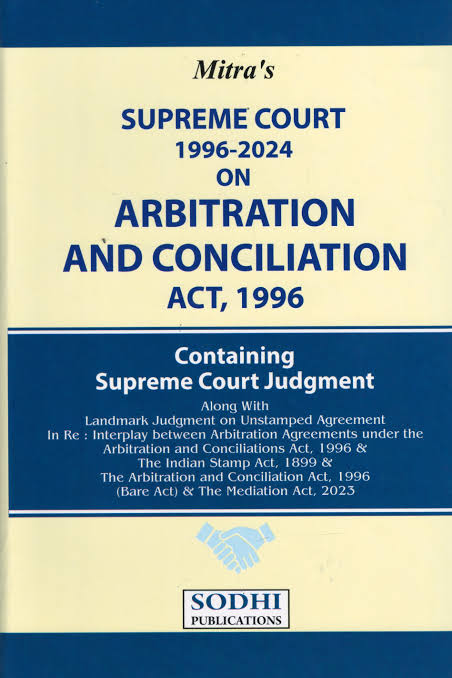
Mitra's Supreme Court on Arbitration and Conciliation Act, 1996 (1996-2024) - 1st Edition 2025
| Author : | Arindam Mitra |
|---|
| A section-wise digest of Supreme Court judgments on the Arbitration and Conciliation Act, 1996, covering the full span from 1996 to 2024 in 652 hardbound pages. Arindam Mitra arranges nearly three decades of arbitration jurisprudence provision by provision — arbitration agreements and stamping, reference under Sections 8 and 45, interim measures under Sections 9 and 17, appointment under Section 11, arbitrator ineligibility, kompetenz-kompetenz, arbitrability, Section 29A timelines, setting aside under Section 34, appeals under Section 37, enforcement under Section 36 and foreign awards under Part II — with each entry giving the case name, citation, facts, issue, holding and reasoning. The volume carries a full analysis of the landmark reference on unstamped and inadequately stamped arbitration agreements, and reproduces the Arbitration and Conciliation Act, 1996 and the Mediation Act, 2023 as Bare Acts along with comparative notes on the Indian Stamp Act, 1899. 1st Edition 2025, Sodhi Publications. |


652

English

1st Edition, 2025

Tags: Arbitration & Conciliation ( ADR ), BARE ACT, Supreme Court, Case Digest
Mitra's Supreme Court on Arbitration and Conciliation Act, 1996 (1996–2024) by Arindam Mitra, published by Sodhi Publications, is a complete section-wise digest of every significant ruling the Supreme Court of India has delivered on the Arbitration and Conciliation Act, 1996 — from the Act's commencement right through to 2024. In a single hardbound volume of 652 pages, it gathers nearly three decades of arbitration jurisprudence and arranges it so that a practitioner can open the book at a section number and immediately see how the Court has read it.
Arbitration law in India is almost entirely judge-made in its practical detail. The statute is short; the law that governs real disputes lives in the Supreme Court's reading of it, through the 2015, 2019 and 2021 amendments and through a steady stream of Constitution Bench and three-Judge Bench decisions on stamping, arbitrability, the scope of Section 11, the limits of Section 34 and the enforcement of foreign awards. A counsel arguing a Section 34 petition or resisting a Section 9 application needs the current position, not the position as it stood when the last edition of a textbook went to press. This digest exists to give exactly that: the authority, stated accurately, with the citation, found quickly.
Key Features
- Judgments arranged section-wise under the Arbitration and Conciliation Act, 1996, so research begins from the provision in issue rather than from a subject index.
- Full coverage from 1996 to 2024 — the entire life of the Act, including the position after the 2015, 2019 and 2021 amendments.
- Detailed treatment of the unstamped arbitration agreement question, including the landmark In Re: Interplay between Arbitration Agreements under the Arbitration and Conciliation Act, 1996 and the Indian Stamp Act, 1899 reference, printed and analysed at length.
- Bare Act text of the Arbitration and Conciliation Act, 1996 reproduced as amended, so the provision and the case law on it sit in the same volume.
- Bare Act text of the Mediation Act, 2023 — essential now that the Mediation Act has amended Part III of the 1996 Act and reshaped the conciliation framework.
- Comparative notes on the Indian Stamp Act, 1899 where it bears on the validity and enforceability of arbitration agreements.
- Each digest carries the case name, full citation, facts, issue, holding and reasoning — enough to cite the authority with confidence without pulling the full report.
- Table of Cases, subject index and cross-references throughout, for approach from any direction.
- Hardbound, 652 pages, 1st Edition 2025 — built to survive daily chamber and court use.
Coverage
- Arbitration agreement and its validity: what constitutes a written agreement, incorporation by reference, group of companies doctrine, non-signatories, and the effect of insufficient or absent stamping.
- Reference to arbitration — Section 8 and Section 45: the court's duty to refer, the scope of judicial examination at the referral stage, and the treatment of fraud and allegations of forgery.
- Interim measures — Section 9 and Section 17: the test for grant, the relationship between court-ordered and tribunal-ordered relief, and the position after an arbitral tribunal is constituted.
- Appointment of arbitrators — Section 11: the limited scope of enquiry, limitation on the Section 11 petition, unilateral appointment clauses and the ineligibility grounds of the Seventh Schedule.
- Independence, impartiality and challenge: Sections 12 to 15, the Fifth and Seventh Schedules, de jure and de facto inability, and the consequences of a tribunal's termination of mandate.
- Jurisdiction and kompetenz-kompetenz — Section 16: the tribunal's power to rule on its own jurisdiction and the stage at which a court may intervene.
- Arbitrability: the categories of dispute that remain outside arbitration — fraud, tenancy, consumer, insolvency, intellectual property, trust and criminal matters — as the Court has settled them.
- Procedure, evidence and the conduct of proceedings: Sections 18 to 27, party autonomy over procedure, time limits under Section 29A and substitution of the arbitrator.
- The award — Section 31 and Section 33: form and contents, reasons, interest, costs, correction and interpretation, and additional awards.
- Setting aside — Section 34: the public policy ground as narrowed, patent illegality, perversity, the prohibition on modification of an award, limitation and condonation, and the limits of the court's role.
- Appeals — Section 37: what is appealable, the standard of interference, and the still narrower scope at the second appellate stage.
- Enforcement of domestic awards — Section 36: the position on automatic stay before and after the 2015 amendment, and conditions for stay of enforcement.
- Foreign awards — Part II: New York Convention and Geneva Convention awards, the grounds for refusing enforcement, the seat and venue distinction, and the applicability of Part I to foreign-seated arbitrations.
- Seat, venue and governing law: the line of authority settling which court has supervisory jurisdiction.
- Institutional arbitration and the emerging jurisprudence on institutional rules and emergency arbitrators.
- Conciliation and mediation: Part III of the 1996 Act as amended and the Mediation Act, 2023 framework.
Who Should Buy This Book?
- Advocates and arbitration counsel appearing in Section 9, 11, 34 and 37 matters before the High Courts and the Supreme Court.
- Arbitrators — retired judges, senior advocates and professional arbitrators — who need the controlling authority on a procedural or jurisdictional objection at short notice.
- Judges and judicial officers of the Commercial Courts, District Courts and High Courts hearing arbitration petitions and appeals.
- In-house counsel and corporate legal teams drafting arbitration clauses and managing commercial disputes.
- Infrastructure, construction, energy and PSU legal departments where arbitration is the standard route for contractual claims.
- Law firms and chambers maintaining an arbitration practice and needing a single current reference on the shelf.
- Judicial service aspirants and LL.M. students specialising in ADR, and candidates preparing for arbitration-focused papers.
- Law libraries, bar associations and arbitral institutions building a reliable ADR reference collection.
Why Choose This Book?
Most arbitration books are commentaries: the author's exposition, with case law cited in support. This is the other kind of book, and the one a practitioner reaches for under time pressure — a digest that puts the Supreme Court's own holdings front and centre, section by section, with the facts and reasoning set out well enough to cite. Because it runs from 1996 to 2024 without a break, it also shows the movement of the law: where a position was taken, where it was doubted, and where a larger Bench finally settled it. That trajectory matters in arbitration more than in almost any other field, because so much of the current law consists of corrections to earlier readings.
Including the bare text of both the Arbitration and Conciliation Act, 1996 and the Mediation Act, 2023, together with the stamping notes, makes the volume genuinely self-contained: the provision, the governing authority and the allied statute are all between the same covers. For a first edition from Sodhi Publications on this subject, the coverage is unusually complete, and it is current through the most consequential arbitration ruling of recent years on unstamped agreements.