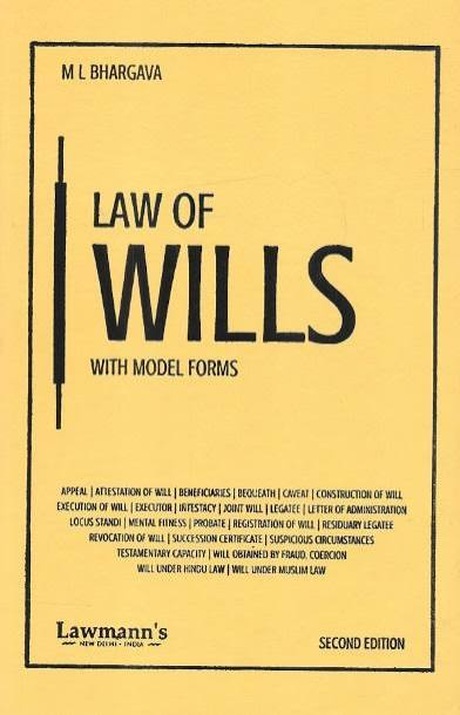
Lawmann's Law of Wills With Model Forms - 2nd Edition
| Author : | M. L. Bhargava |
|---|
| Lawmann's Law of Wills with Model Forms by M. L. Bhargava, Second Edition, is a practitioner's work on the making, proving and challenging of wills in India, supplied with model forms for drafting. It covers the essentials of a will, codicils, privileged and joint wills, testamentary capacity and mental fitness, execution and the requirement of two attesting witnesses, proof of a will in court, registration, suspicious circumstances and the duty of the propounder, wills obtained by fraud or coercion, the construction of wills with legatees and residuary legatees, revocation and alteration, executors and administrators, the procedure for probate, letters of administration and succession certificates including locus standi, caveat and appeal, intestacy, and the will under Hindu law and under Muslim law. The model forms cover wills, codicils, revocation clauses, probate petitions, caveats and allied documents. English, ISBN 9789385114755. |


Tags: Deed & Documents, Law of Wills, The Indian Succession Act, Succession Partition and Wills
Lawmann's Law of Wills — With Model Forms by M. L. Bhargava, published by Lawmann's, is the Second Edition of a practitioner's work on the making, proving and challenging of wills in India, with a set of model forms for drafting. English.
A will is the one document a lawyer drafts knowing that the person best placed to explain it will not be available when it is read. Everything therefore depends on the drafting and on the formalities — attestation, capacity, the absence of suspicious circumstances — because those are the grounds on which the document will later be attacked. Indian testamentary litigation is, in practice, litigation about exactly those points: whether the testator was of sound disposing mind, whether two witnesses attested in the manner the statute requires, and whether the propounder has removed the suspicion that surrounds the will.
This book is organised around that reality. It states the law of testamentary succession, works through the grounds on which wills are challenged, sets out the procedure for probate, letters of administration and succession certificates, and then supplies the model forms — which is what a practitioner actually needs on the desk when a client asks for a will to be drawn.
Key Features
- Second Edition, published by Lawmann's
- Model forms for wills, codicils, petitions and allied documents
- Covers the law of wills under Hindu law and Muslim law as well as the Indian Succession Act
- Detailed treatment of attestation, testamentary capacity and suspicious circumstances
- Full procedure for probate, letters of administration and succession certificates
- Written for drafting and for litigation, with the leading authority on each point
- English · ISBN 9789385114755
Coverage
The Will and Its Essentials. What constitutes a will, the difference between a will and a gift or settlement, codicils, privileged and unprivileged wills, joint and mutual wills, and conditional and contingent bequests.
Testamentary Capacity. Mental fitness and a sound disposing mind, age and competence, the effect of illness, old age or infirmity, and the burden of proving capacity.
Execution and Attestation. The signature of the testator, signature by another at his direction, the requirement of two attesting witnesses, what attestation means in law, the proof of a will in court, and the position where an attesting witness is dead or unavailable.
Registration of Wills. Whether registration is necessary, its evidentiary effect, deposit of a will with the Registrar, and the procedure on the testator's death.
Suspicious Circumstances and Invalidity. Suspicious circumstances and the duty of the propounder to dispel them; wills obtained by fraud, coercion or undue influence; forged and fabricated wills; and the approach of the courts where the propounder is also the principal beneficiary.
Construction of Wills. The rules of construction, the intention of the testator, repugnant and inconsistent clauses, legatees and residuary legatees, lapse and ademption of legacies, and bequests to a class.
Revocation and Alteration. Revocation of a will expressly and by implication, by a later will or codicil, by destruction, the effect of alterations and interlineations, and revival.
Executors and Administrators. The appointment, powers and duties of an executor, renunciation, administration of the estate, and the position of an administrator.
Probate and Letters of Administration. Who may apply and where, locus standi, the petition and its contents, caveat and the conversion of proceedings into a suit, the grant and its effect, revocation of a grant, and appeal.
Succession Certificates. When a succession certificate is required, the procedure for obtaining one, and how it differs from probate and letters of administration.
Intestacy. Intestate succession where there is no will or the will fails, and the devolution of the estate.
Wills under Personal Law. The will under Hindu law and the operation of the Hindu Succession Act, and the will under Muslim law with the one-third rule and the requirement of heirs' consent.
Model Forms. Drafts of simple and detailed wills, codicils, revocation clauses, petitions for probate, letters of administration and succession certificates, caveats and allied documents.
Who Should Buy This Book?
- Advocates drafting wills and appearing in testamentary and succession matters
- Civil and probate court practitioners
- Judicial officers hearing testamentary petitions and civil suits on wills
- Notaries, document writers and conveyancers
- Chartered accountants, financial and estate planners
- LL.B. and LL.M. students taking succession, family law or drafting papers
- Candidates for judicial service and drafting-based examinations
- Anyone making a will who wants to understand what makes one hold up
- Law college and court libraries
Why Choose This Book?
The model forms are the practical argument for this book. A will that is litigated is usually one that was badly drawn, and a reliable set of precedents — for the simple will, the will with a life interest, the codicil, the revocation clause, the probate petition — prevents most of the problems the rest of the book is about.
The second reason is the coverage of personal law. Indian testamentary practice is not governed by one statute. A Hindu testator, a Muslim testator and a testator governed by the Indian Succession Act are in materially different positions, and a book that treats all three in one place is more use than one that treats only the general law.
The third is the emphasis on suspicious circumstances. That doctrine decides more Indian will cases than any other, and the practitioner who understands what a court looks for — and what the propounder must be ready to prove — is already most of the way to the result.