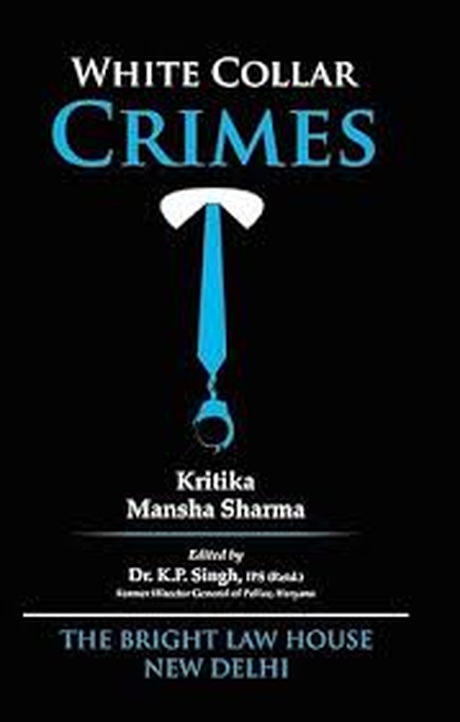
Bright's White Collar Crimes - 1st Edition 2025
| Author : | Kritika, Mansha Sharma, Dr. K. P. Singh, IPS (Retd.) |
|---|
| A textbook on white collar crime written for the Indian syllabus and edited by Dr. K. P. Singh, IPS (Retd.), former Director General of Police, Haryana. Kritika and Mansha Sharma work through the concept and its boundaries, why these offences are harder to detect and prove than conventional crime, and then the offences themselves — commercial fraud, embezzlement and criminal breach of trust, insider trading and securities manipulation, banking and loan fraud, money laundering, corruption and bribery, tax evasion, cybercrime and identity theft, professional misconduct, and offences in trade and industry such as adulteration and profiteering. The treatment is interdisciplinary, drawing on law, economics, psychology and sociology to explain the motivations and methods behind the conduct, and covers both the Indian legal framework and the international one, with recent legislative developments and real-world case studies. A concluding part deals with prevention through corporate governance, codes of ethics, internal controls and audit. 1st Edition 2025, 225 pages, The Bright Law House, New Delhi. |


225

English

1st Edition, 2025

Tags: Criminology & Penolgy with Victimology, Cyber Law, Money Laundering, Criminal Law
White Collar Crimes by Kritika and Mansha Sharma, edited by Dr. K. P. Singh, IPS (Retd.), former Director General of Police, Haryana, published by The Bright Law House, New Delhi, is a textbook on the offences that are committed from behind a desk rather than in the street. First Edition, 2025, 225 pages.
White collar crime is the branch of criminal law where the gap between the harm done and the attention paid is widest. A single accounting fraud can destroy more wealth than every burglary in a city in a year, yet the offence is harder to detect, harder to investigate, harder to prove and far less likely to end in conviction. The reasons are structural: the offender has authority, the records are in the offender's custody, the loss is diffuse, and the conduct is often only a short step from what is ordinary commercial practice. This book takes that structure as its subject.
The editorial hand of Dr. K. P. Singh, a former Director General of Police of Haryana, is what distinguishes it from a purely academic treatment. The book is interdisciplinary by design — drawing on law, economics, psychology and sociology — because the question "why does a person who already has money steal?" is not a legal question, and an investigator who cannot answer it will not know where to look.
Key Features
- A textbook treatment of white collar crime written for the Indian syllabus and the Indian regulatory framework.
- Edited by Dr. K. P. Singh, IPS (Retd.), former Director General of Police, Haryana.
- Interdisciplinary approach — law, economics, psychology and sociology — rather than offence definitions alone.
- Real-world case studies illustrating how these frauds were actually carried out and uncovered.
- Both the domestic and the international legal framework, including recent legislative developments.
- A full part on prevention: corporate governance, ethical practice and internal controls.
- Compact and affordable — 225 pages, paperback, at a student price.
- 1st Edition, 2025, from The Bright Law House.
Coverage
- The concept of white collar crime: Sutherland's formulation, how the category has been redefined since, and how it is distinguished from conventional and from organised crime.
- Why white collar crime is different: the offender's social position, the absence of an identifiable victim, the difficulty of proving mens rea, and the low rate of reporting and conviction.
- Fraud in its commercial forms — misrepresentation, falsification of accounts, and fraud on creditors and investors.
- Embezzlement, criminal breach of trust and misappropriation by those in a fiduciary or employment relationship.
- Corporate and securities offences: insider trading, market manipulation, false disclosure and the role of the regulator.
- Banking and financial offences: loan fraud, wilful default, cheque and instrument offences, and fraud on the public exchequer.
- Money laundering — placement, layering and integration, and the statutory machinery for attachment and confiscation.
- Corruption and bribery, and the law on public servants.
- Tax evasion, and the line between avoidance and evasion.
- Cybercrime as white collar crime: online fraud, identity theft, data theft and the misuse of electronic records.
- Professional misconduct in the medical, legal, engineering and accounting professions.
- Offences in trade and industry: adulteration, hoarding, profiteering and the sale of substandard goods.
- Motivations and methods: the psychology of the offender and the sociology of the organisation that enables the conduct.
- The Indian legal framework and the agencies that enforce it.
- The international framework, cross-border offences and cooperation between jurisdictions.
- Case studies drawn from actual frauds and prosecutions.
- Prevention: corporate governance, codes of ethics, internal controls, audit and whistleblower protection.
Who Should Buy This Book?
- LL.B. and LL.M. students taking White Collar Crime, Criminology or Economic Offences as a paper.
- Criminology and police science students, for whom this is core reading.
- Police officers and investigating officers in economic offences wings and fraud units.
- Officers of the enforcement and regulatory agencies, and candidates for departmental examinations in those services.
- Advocates practising in economic offences, corporate fraud and money laundering matters.
- Chartered Accountants, Company Secretaries and internal auditors, and compliance and risk teams.
- Corporate governance and ethics officers, and those designing internal controls.
- Civil services aspirants, where economic offences and governance are examinable.
- Law college and police academy libraries.
Why Choose This Book?
Most of the Indian writing on this subject falls into one of two camps. There are the statute-led books, which set out the Prevention of Money Laundering Act or the securities regulations provision by provision and treat the criminology as background. And there are the criminology texts, which discuss Sutherland and the sociology of the corporation at length and barely engage with the law as it stands. A student sitting a White Collar Crime paper, and an officer trying to understand a case file, both need the two halves together.
That is what this volume sets out to do, and the editorial involvement of a former Director General of Police is the reason it reads as it does: the emphasis falls on detection, proof and prevention rather than on classification. At 225 pages it is a book that can be read through rather than consulted, and at this price it is an easy addition to a reading list — which matters for a subject that is increasingly taught but still thinly served by Indian textbooks.