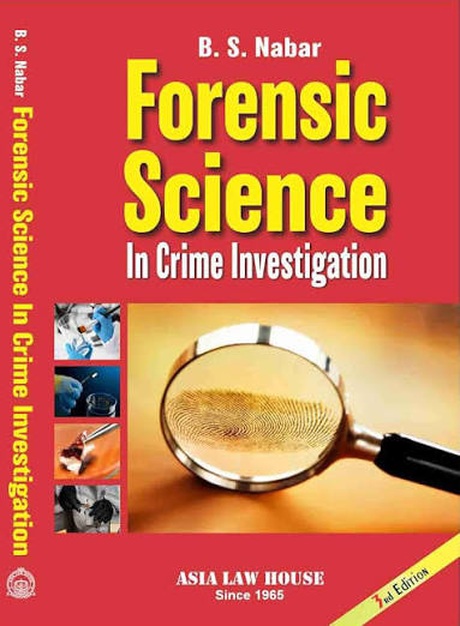
Asia Law House's Forensic Science in Crime Investigation - 3rd Edition 2024
| Author : | B. S. Nabar |
|---|
| A practical forensic science textbook written from the investigator's side, by an author with years of teaching experience at a premier national training institution for senior police officers. B. S. Nabar covers the crime scene and its protection, search, documentation and photography, the classes of physical evidence and the correct collection, packing, sealing and forwarding of each, fingerprints and latent print development, footprints, tool marks and tyre marks, questioned documents and handwriting, ballistics and firearm injuries, blood and body fluids, hair and fibre, DNA profiling, forensic chemistry and toxicology, narcotics, explosives and arson, forensic medicine for the investigator, and report writing and courtroom presentation by the scientific witness. This revised third edition adds two new chapters — the law and court rulings on expert evidence, and computer crime — and every chapter ends with objective-type questions for self-testing and examination revision. 424 pages, paperback, Asia Law House. |


424

English

3rd Edition (Reprint 2024

Tags: Criminology & Penolgy with Victimology, Evidence Law, Forensic Science, Criminal Trial
Forensic Science in Crime Investigation by B. S. Nabar, published by Asia Law House, is a working textbook on how science is actually applied at a crime scene and in the laboratory, written by an author with years of teaching experience at a premier national training institution for senior police officers. Third Edition, 424 pages.
This is the investigator's side of forensic science. Where a law textbook asks what weight a report will carry in court, this book asks the questions that come earlier: what trace is likely to be present, how it must be collected and packed so that it survives the journey to the laboratory, which examination will answer the question the investigating officer actually needs answered, and what the report can and cannot establish. Those decisions are made in the first hours of a case, and a case that is mishandled at that stage cannot be repaired by the best expert evidence afterwards.
The third edition is revised and updated throughout, with improved content and two substantial additions: a chapter on the law and court rulings on expert evidence, and a chapter on computer crime. Every chapter closes with objective-type questions, which makes the book serve equally as a course text and as revision material for examinations and departmental promotion tests.
Key Features
- Written by a teacher of senior police officers — the emphasis throughout is on what an investigator must do, in what order, and why.
- Two new chapters in this edition: laws and court rulings on expert evidence, and computer crime.
- Objective-type questions at the end of every chapter, for self-testing and examination revision.
- Clear, simple and precise treatment of the science — written to be understood by readers without a laboratory background.
- Practical guidance on collection, packing, sealing and forwarding of each class of physical evidence.
- Serves as both a textbook and a handbook — a course book for forensic science students and a desk reference for working professionals in the criminal justice system.
- 3rd Edition, 424 pages, paperback, from Asia Law House — a compact single volume at a student price.
Coverage
- Forensic science and the criminal justice system: the scope of the subject, the structure of the forensic laboratory network in India, and the services each division provides.
- The crime scene: protection and preservation of the scene, systematic search methods, documentation by notes, sketching and photography, and the sequence of operations.
- Physical evidence: the classes of trace evidence, the principle of exchange, and the distinction between identification and comparison.
- Collection, packing and forwarding: correct containers for each type of exhibit, sealing, labelling, the chain of custody and the forwarding note to the laboratory.
- Fingerprints: classification, development of latent prints, lifting and preservation, comparison and the evidentiary standing of a fingerprint identification.
- Footprints, footwear and tyre marks, tool marks, and the examination of restored erased marks.
- Questioned documents: handwriting and signature comparison, forgery, alterations and erasures, ink and paper examination, and typewriting and printing.
- Ballistics: firearms and ammunition, identification of a weapon from a fired bullet or cartridge case, range of firing, residues, and the examination of firearm injuries.
- Biological evidence: blood and bloodstain pattern, semen and other body fluids, hair and fibre.
- DNA profiling: the basis of the technique, the kinds of question it can settle, sample requirements, and its use in identification and in sexual offence and paternity matters.
- Forensic chemistry and toxicology: poisons, drugs and narcotics, alcohol, petroleum products and explosives.
- Fire and explosion investigation, and the examination of arson scenes.
- Forensic medicine for the investigator: injuries, cause and time of death, and the use of the post-mortem report.
- Computer crime — the forms it takes, the digital evidence it leaves, and the handling of electronic exhibits.
- The law of expert evidence: the statutory basis, the court rulings on the admissibility and weight of an expert's opinion, and the expert in the witness box.
- Report writing and courtroom presentation by the scientific witness.
Who Should Buy This Book?
- Forensic science students on B.Sc. and M.Sc. programmes, for whom this is a course text.
- Police officers and investigating officers, including candidates for departmental examinations and promotion tests.
- Probationers and trainees at police academies and detective training schools.
- Criminal lawyers and Public Prosecutors who want to understand what was done to an exhibit before the report reached them.
- Defence counsel preparing to cross-examine a scientific witness on collection, packing and chain of custody — where most forensic cases are actually won or lost.
- Judicial officers and judicial service aspirants needing a working grasp of scientific evidence.
- Criminology and police science students, and LL.B. students taking Forensic Science as a paper.
- Police academy, forensic laboratory and law college libraries.
Why Choose This Book?
The useful question about a forensic science book is who it was written for. Books written by laboratory scientists tend to treat the crime scene as a place exhibits arrive from. Books written by lawyers start at the point where the report is tendered. Nabar's book sits where the work is actually done — it is built around the investigating officer's decisions, and it came out of years of teaching precisely those officers. That is why it reads as instruction rather than as description.
The objective-type questions at the end of each chapter are a small feature that matters a great deal in practice: they make the book usable for self-study, which is how most serving officers and most forensic science students actually get through it. Add the new chapters on expert evidence and computer crime, and 424 pages at this price make it one of the better-value forensic science texts on the Indian market — comprehensive enough for a degree course, compact enough to keep on a working desk.