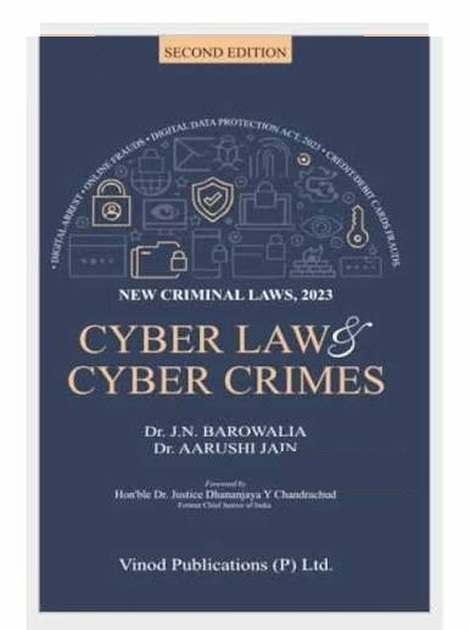
Vinod's Cyber Law & Cyber Crimes - New Criminal Laws, 2023 - 2nd Edition
| Author : | Dr. J N Barowalia, Dr. Aarushi Jain |
|---|
| Vinod's Cyber Law & Cyber Crimes - New Criminal Laws, 2023 by Dr. J. N. Barowalia and Dr. Aarushi Jain, Second Edition, with a Foreword by Hon'ble Dr. Justice Dhananjaya Y. Chandrachud, former Chief Justice of India, is a comprehensive treatise bringing cyber law into the framework of India's post-2023 statutes. It covers the Information Technology Act, 2000, the Digital Personal Data Protection Act, 2023 and the Bharatiya Nyaya Sanhita, Bharatiya Nagarik Suraksha Sanhita and Bharatiya Sakshya Adhiniyam, 2023, and works through hacking, phishing and identity theft, credit and debit card and e-commerce frauds, digital arrest and social engineering scams, cyber stalking, bullying and deepfakes, ransomware and data breaches, cyber terrorism, privacy and the DPDP regime of consent and data fiduciaries, intermediary liability and safe harbour, the admissibility of electronic evidence and the certificate required, search and seizure of digital devices, adjudication and appeals, and emerging issues in artificial intelligence and virtual digital assets. English, ISBN 9789391088095. |


1693

English

2nd Edition 2026

Tags: Cyber Law, Information Technology Law, New Criminal Law, Digital Data Protection
Vinod's Cyber Law & Cyber Crimes — New Criminal Laws, 2023 by Dr. J. N. Barowalia and Dr. Aarushi Jain, published by Vinod Publications (P) Ltd., is the Second Edition of a comprehensive treatise on cyber law in India, carrying a Foreword by Hon'ble Dr. Justice Dhananjaya Y. Chandrachud, former Chief Justice of India. English.
Cyber law in India changed twice over in a single stretch. First the Digital Personal Data Protection Act, 2023 created, for the first time, a statutory regime for personal data, consent and the obligations of data fiduciaries. Then the three new criminal laws — the Bharatiya Nyaya Sanhita, the Bharatiya Nagarik Suraksha Sanhita and the Bharatiya Sakshya Adhiniyam, 2023 — came into force on 1 July 2024, renumbering the offences, rewriting the procedure for digital investigation and search, and placing electronic records squarely within the definition of primary evidence.
Meanwhile the conduct itself kept moving. Digital arrest scams, online investment and loan-app frauds, credit and debit card fraud, ransomware, deepfakes and data breaches are now the everyday work of cyber cells and the courts. This Second Edition has been revised to take in all of it, and the authors set the Information Technology Act, 2000 against the newer statutes so that a reader can see which law applies to which conduct, and how they interact.
Key Features
- Second Edition, Vinod Publications (P) Ltd.
- Foreword by Hon'ble Dr. Justice D. Y. Chandrachud, former Chief Justice of India
- Covers the Information Technology Act, 2000 and the Digital Personal Data Protection Act, 2023
- Integrated with the new criminal laws of 2023 — BNS, BNSS and the Bharatiya Sakshya Adhiniyam
- Detailed treatment of digital arrest, online frauds and credit/debit card frauds
- Electronic evidence and digital investigation procedure
- Landmark judicial decisions and emerging technology-related legal issues
- Written for the Bench, the Bar and enforcement agencies alike · English · ISBN 9789391088095
Coverage
Foundations of Cyber Law. The growth of information and communication technology and the legal problems it creates; jurisdiction in cyberspace; and the architecture of the Information Technology Act, 2000 with its amendments.
Digital Signatures and Electronic Governance. Electronic and digital signatures, certifying authorities, electronic records and their legal recognition, and the attribution, acknowledgement and despatch of electronic records.
Cyber Offences. Hacking and unauthorised access, data theft, phishing and identity theft, cheating by personation, source-code tampering, denial-of-service attacks, ransomware and malware.
Financial and E-Commerce Frauds. Credit and debit card frauds, UPI and net-banking fraud, online investment and loan-app scams, e-commerce and marketplace fraud, and the liability of intermediaries and banks.
Digital Arrest and Social Engineering. The "digital arrest" modus operandi and allied impersonation scams, the offences made out, and the practical difficulties of investigation and recovery.
Offences Against the Person. Cyber stalking, cyber bullying, online harassment, obscene and sexually explicit material, offences against children, voyeurism, revenge content and deepfakes.
Cyber Terrorism and Security. Cyber terrorism, attacks on critical information infrastructure, and the national cyber security framework.
Privacy and Data Protection. The right to privacy as a fundamental right; the Digital Personal Data Protection Act, 2023 — data principals and data fiduciaries, consent, notice, the rights of individuals, the Data Protection Board and penalties; and data breaches.
Intermediary Liability. The safe-harbour provision, due diligence obligations, the intermediary guidelines, take-down and blocking, and the position of social media and significant intermediaries.
Electronic Evidence. The admissibility of electronic and digital records under the Bharatiya Sakshya Adhiniyam, 2023, the required certificate, forensic examination of devices, hash values, and the appreciation of digital evidence at trial.
Investigation and Procedure. Registration and investigation of cyber offences, search and seizure of digital devices, preservation of data, the powers of the police and specialised agencies under the Bharatiya Nagarik Suraksha Sanhita, and jurisdiction.
Cyber Offences under the New Criminal Laws. The provisions of the Bharatiya Nyaya Sanhita, 2023 touching technology-enabled crime — organised crime, fraud, forgery of electronic records and allied offences — with their IPC equivalents.
Adjudication and Appeals. The adjudicating officer, the Telecom Disputes Settlement and Appellate Tribunal, penalties and compensation, and appeals.
Emerging Issues. Artificial intelligence, cryptocurrency and virtual digital assets, cloud storage and cross-border data flows, and the regulatory questions they raise.
Who Should Buy This Book?
- Judges and judicial officers trying cyber and electronic-evidence matters
- Advocates practising in cyber crime, data protection and technology law
- Public prosecutors and law officers
- Police, cyber cells and investigating agencies, and police training academies
- In-house counsel, compliance officers and data protection officers
- Information security and digital forensics professionals
- LL.M. students, research scholars and teachers of cyber law
- Policymakers, regulators and banks' fraud-risk teams
- Law college, court and institutional libraries
Why Choose This Book?
The first reason is integration. Most cyber law books in the market are commentaries on the Information Technology Act with a chapter bolted on for data protection. This one treats the IT Act, the DPDP Act and the three new criminal laws as a single working field — which is how a case actually arrives, since a single complaint may raise an offence under the Sanhita, an evidentiary question under the Sakshya Adhiniyam and a compliance failure under the DPDP Act at once.
The second is its attention to how fraud is actually committed now. Digital arrest, loan-app coercion, card-not-present fraud and deepfakes are recent enough that older editions and older texts simply do not address them. For an investigating officer or a prosecutor, that currency is the whole value of the book.
The third is standing. A foreword by Justice D. Y. Chandrachud — who as Chief Justice of India presided over the court's own digital transition and wrote extensively on privacy — is a meaningful endorsement in a field where authority is still being settled.