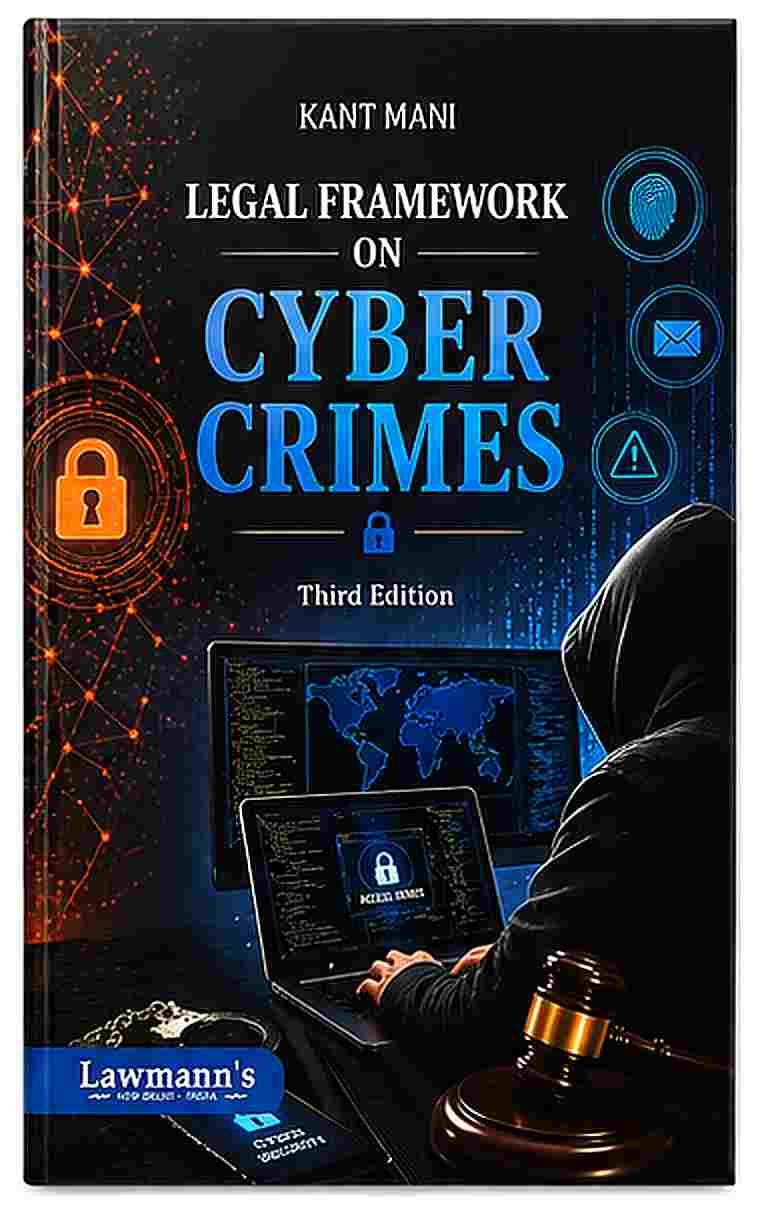
Lawmann's Legal Framework On Cyber Crimes - 3rd Edition 2027
| Author : | KANT MANI |
|---|
| Lawmann's Legal Framework on Cyber Crimes by Kant Mani, 3rd Edition, is a practitioner's guide to the law governing crime committed through computers and networks in India. It opens with an overview of information technology and the concept of cyber space, works through the offences and the legal framework under the Information Technology Act, 2000, and gives particular attention to the admissibility of digital evidence - the question on which most cyber prosecutions actually turn. The volume carries 23 appendices reproducing the IT Act, 2000 together with the rules, regulations and procedures made under it, covering cyber security, digital signatures and the intermediary guidelines, so that the governing text sits with the commentary in one book. |


Tags: Cyber Law, Information Technology Law, Electronic Evidence, Criminal Law
Legal Framework on Cyber Crimes by Kant Mani, published under the Lawmann's imprint of Kamal Publishers, is a guide to the law governing crime committed through computers and networks in India. This is the Third Edition.
Cyber crime is prosecuted under a framework that most criminal practitioners meet only occasionally and that changes faster than any other part of the criminal law. The offences sit in one statute, the procedure and the evidence rules in others, and a great deal of what actually decides a case is buried in rules and guidelines made under the Information Technology Act rather than in the Act itself. This book puts that framework together.
What the Book Covers
- Overview of information technology — the technical vocabulary a lawyer needs before the law makes sense
- Cyber space — the concept, and the jurisdictional problems that follow from it
- Cyber offences under the Information Technology Act, 2000 and the general criminal law
- Admissibility of digital evidence — electronic records, certification, and the question on which most cyber prosecutions actually turn
- Digital signatures and electronic authentication
- Cyber security and the obligations it imposes
- Intermediary guidelines and the liability of platforms
- Investigation and the powers of the authorities
23 Appendices
The volume reproduces the Information Technology Act, 2000 together with 23 appendices of the rules, regulations and procedures made under it — so that the governing text sits alongside the commentary rather than in a separate bare act.
Key Features
- Third Edition, published by Lawmann's (Kamal Publishers)
- Commentary and statutory material in a single volume
- Dedicated treatment of digital evidence and its admissibility
- 23 appendices of rules, regulations and procedures
- Written for practitioners as well as students
- Paperback, English
- ISBN 978-93-84668-57-0
Who Should Buy This Book?
- Criminal practitioners handling cyber crime prosecutions and defences
- Police officers and cyber crime cell investigators
- Public Prosecutors
- Judges and judicial officers hearing cyber matters
- In-house counsel and compliance officers of intermediaries and platforms
- Information security and forensic professionals working with the legal process
- LL.B. and LL.M. students taking Cyber Law or Information Technology Law
- Law libraries and institutional collections
Why Choose This Book?
In a cyber case the substantive offence is usually the easy part. What decides the outcome is whether the electronic record can be proved — whether it was properly seized, whether the certificate accompanying it is in order, and whether the chain of custody holds. A book that treats digital evidence as a subject in its own right, rather than a paragraph at the end, is far more use in court.
Carrying the Act and its 23 sets of subordinate rules in the same volume also matters in practice, because so much of the framework — the intermediary obligations, the security standards, the certifying authority procedures — lives in the rules rather than the statute.