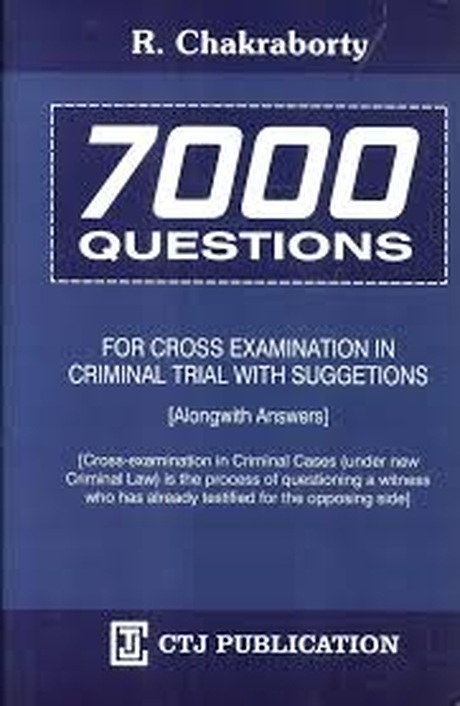
CTJ's 7000 Questions for Cross Examination in Criminal Trial with Suggestions (Alongwith Answers) - 3rd Edition 2026
| Author : | R CHAKRABORTY |
|---|
| Seven thousand ready-framed cross-examination questions for the criminal trial court, with answers and strategic suggestions alongside, revised for the Bharatiya Nyaya Sanhita, 2023, the Bharatiya Nagarik Suraksha Sanhita, 2023 and the Bharatiya Sakshya Adhiniyam, 2023. R. Chakraborty, Advocate, Supreme Court of India, arranges the sets witness by witness — complainant and first informant, eyewitness, test identification parade, investigating officer, medical officer and post-mortem, ballistics, handwriting, fingerprint and DNA experts, electronic evidence and CDR, panch and seizure witnesses, hostile witnesses and defence witnesses — and again offence by offence, covering murder, grievous hurt, sexual offences, dowry death, kidnapping, robbery, cheating and forgery, NDPS, POCSO, SC/ST Act, Domestic Violence and Section 138 cases. The successor to the author's 4500 Questions. 3rd Edition 2026, CTJ Publication, hardbound. |


Tags: Evidence Law, Criminal Trial, Criminal Law, Art Of Cross Examination
7000 Questions for Cross Examination in Criminal Trial with Suggestions (Alongwith Answers) by R. Chakraborty, Advocate, Supreme Court of India, published by CTJ Publication, is a working arsenal of ready-to-use cross-examination questions for the criminal trial court — now revised for the new criminal laws. Third Edition, 2026.
Cross-examination is the one part of a criminal trial that cannot be prepared from a textbook statement of principle. What wins a case is the question actually put, in the right order, to the right witness. Yet most advocates learn this only by watching seniors and by losing a few trials first. This book shortens that apprenticeship. It sets out seven thousand questions — arranged by the kind of witness and the kind of case — with suggestions on how to deploy them and, importantly, with answers, so the reader can see where each line of questioning is meant to lead and what to do when the witness does not give the expected reply.
The present edition has been rewritten against the Bharatiya Nyaya Sanhita, 2023, the Bharatiya Nagarik Suraksha Sanhita, 2023 and the Bharatiya Sakshya Adhiniyam, 2023. That matters more than it might sound: cross-examination is built on the law of evidence, and the renumbering and redrafting of the evidence provisions — previous statements, contradictions, admissions, expert and electronic evidence — changes how an objection is framed and how a contradiction is proved. This is a third edition of a book that began life as the author's well-known 4500 Questions, expanded substantially for the new statutory scheme.
Key Features
- 7,000 ready-framed cross-examination questions for use in criminal trials — not model paragraphs, but questions in the form in which they can be put.
- Answers supplied alongside, so the reader can see the purpose of each line and anticipate the witness's likely response.
- Suggestions on strategy — sequencing, when to press and when to stop, and how to close a door before the re-examination opens it.
- Updated for the new criminal laws: the BNS, 2023, the BNSS, 2023 and the Bharatiya Sakshya Adhiniyam, 2023.
- Organised witness by witness — complainant, eyewitness, investigating officer, medical officer, expert, panch and formal witnesses — so the relevant set is found in seconds.
- Written by a Supreme Court advocate with a long record of trial practice, and the successor to his widely used 4500 Questions.
- 3rd Edition, 2026, hardbound — built for daily carriage to court.
- Practical format aimed squarely at the trial court advocate rather than at the appellate or academic reader.
Coverage
- Cross-examination of the complainant and the first informant: delay in lodging the FIR, omissions and improvements, prior enmity, and testing the genesis of the prosecution case.
- Eyewitnesses: presence at the scene, light and visibility, distance, duration of observation, identification, and the interested or related witness.
- Test identification parades: the manner of conduct, prior showing of the accused, and the evidentiary value of a TIP not followed by dock identification.
- The Investigating Officer: station diary and case diary entries, seizure and sealing, chain of custody, delay in despatch to the FSL, and defects in the investigation.
- Medical officers and post-mortem evidence: nature and duration of injuries, weapon of offence, time of death, and inconsistencies between the medical and ocular accounts.
- Expert witnesses: ballistics, handwriting, fingerprint, chemical and DNA evidence — qualification, methodology, control samples and the limits of an opinion.
- Electronic evidence: CCTV footage, call detail records, mobile data and the certificate requirement under the Bharatiya Sakshya Adhiniyam, 2023.
- Panch and seizure witnesses: stock witnesses, recovery under the disclosure provisions, and the independence of the witness.
- Hostile witnesses and the technique of dealing with a declared hostile witness.
- Contradictions and omissions: proving a previous statement, the correct method of putting a contradiction, and recording it on the deposition.
- Offence-specific question sets: murder and culpable homicide, grievous hurt, rape and sexual offences, dowry death and cruelty, kidnapping and abduction, robbery and dacoity, theft and house-breaking, cheating and forgery, and NDPS cases.
- Special statutes: cross-examination in POCSO, SC/ST (Prevention of Atrocities), Domestic Violence and Negotiable Instruments Act Section 138 proceedings.
- Defence witnesses and alibi, and the cross-examination the prosecution will face in reply.
- Trial mechanics: leading questions, objections, permissible scope, the judge's power to put questions, and recall of a witness.
Who Should Buy This Book?
- Criminal trial court advocates — the primary readership, and the people for whom the book is formatted.
- Junior advocates and first-generation lawyers building a criminal practice without a senior to watch.
- Public Prosecutors and Assistant Public Prosecutors, who face these questions from the other side and must prepare their witnesses accordingly.
- Defence counsel handling serious offences under the BNS and the special statutes.
- Judicial officers and Magistrates, for an appreciation of how cross-examination is structured and what objections are properly taken.
- Judicial service and APO aspirants, where trial procedure and the law of evidence carry heavy weight.
- Law students in moot court and trial advocacy courses, and clinical legal education programmes.
- Bar association and district court libraries.
Why Choose This Book?
There is no shortage of books on the art of cross-examination. Almost all of them are books of principle: they explain why you should never ask a question you do not know the answer to, and they illustrate it with famous cross-examinations from another century and another jurisdiction. Useful reading, but not what an advocate needs at ten in the morning with a hostile eyewitness in the box. This is the other kind of book — a question bank, assembled by someone who has conducted trials, organised so that the right set of questions can be found and adapted on the spot.
The jump from 4,500 questions in the earlier work to 7,000 here is not padding. It reflects the new criminal laws, the expansion of electronic and forensic evidence in ordinary trials, and the growth of special-statute litigation that now takes up much of a trial court's list. For a practitioner who already owns a treatise on evidence, this is the volume that converts that knowledge into the question actually asked.