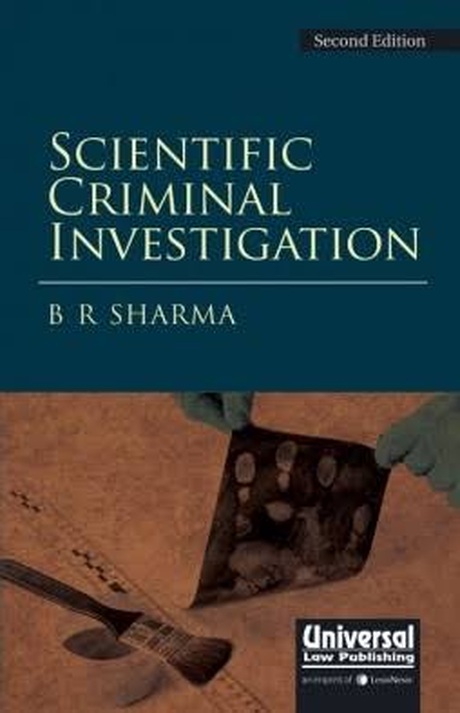
Universal's Scientific Criminal Investigation - 2nd Edition 2025
| Author : | B. R. Sharma |
|---|
| Universal Law Publishing's Scientific Criminal Investigation by Dr. B. R. Sharma, Second Edition, is a 650-page hardbound reference on forensic science as applied to criminal investigation, written for the non-scientist - the investigating officer, prosecutor, defence counsel and judge. It covers basic police work including identification of the individual, interrogation, surveillance, crime detection devices, the scene of occurrence and its sketching, police photography, voice identification, forensic psychology, computer crime and DNA profiling; then the clues class by class - fingerprints, tracks and trails, tool marks, firearms, disputed documents and forgeries, narcotics, poisons, alcohol, explosives, fire and arson, vehicles, blood, semen, hairs, fibres and micro traces; and offences against the person, including death investigation, identification of the dead, time of death, injuries, asphyxia, sexual offences, abortion and infanticide. Carries case histories, illustrations and photographs, with the second edition revised and new topics added. |


650

English

2nd Edition 2025

Tags: Forensic Science, Criminal Trial, Medical jurisprudence, Investigating Officers (I .O)
Universal's Scientific Criminal Investigation by B. R. Sharma – Second Edition 2025
Universal Law Publishing publishes the Second Edition of Dr. B. R. Sharma's Scientific Criminal Investigation, a 650-page hardbound reference on the ground where forensic science and criminal investigation meet. Sharma is among the most widely read Indian authors on forensic science, and this volume is his treatment of the subject written deliberately for the non-scientist — the investigating officer, the prosecutor, the defence counsel and the judge who must understand what a scientific finding is worth without being a scientist.
The book is organised around the investigator's actual problem: a crime has been committed, there is a scene, there are clues, and there is an offender with a method and a modus operandi. It works through the tools and techniques for handling each of those, with case histories, illustrations and photographs throughout. The Second Edition revises the existing material and adds new topics reflecting recent developments in forensics.
What the book covers
Basic police work — the approach of scientific criminal investigation; computers and computer crime; identification of the individual; interrogation; surveillance; crime detection devices; the scene of occurrence and its handling; sketching the scene; police photography; voice identification; forensic psychology; and DNA profiling.
Clues — evidentiary clues generally, and then class by class: fingerprints; tracks and trails; tool marks; firearms; disputed documents and forgeries; narcotics; poisons and poisoning; alcohol; explosives; fire and arson; vehicles; blood; semen; hairs; fibres; and micro traces — with, for each, how it is found, collected, preserved, sent for examination and read in court.
Offences against the person — death investigation; identification of the dead; time of death; injuries; asphyxia; sexual offences; and abortion and infanticide.
Why this book
- Written for the non-scientific reader — the science is explained in terms an investigator or a lawyer can use and cross-examine on.
- Clue-by-clue organisation, so the chapter matches the exhibit in front of the reader.
- Case histories, illustrations and photographs rather than description alone.
- Second Edition, revised throughout with new topics on recent forensic developments.
- From a leading Indian authority on forensic science, in a 650-page hardbound volume.
Who should buy this book
- Police officers and investigating officers at every level, and the investigation and crime branches.
- Public prosecutors and defence counsel who have to lead or challenge expert evidence.
- Judges and judicial officers assessing forensic testimony in criminal trials.
- Forensic science students and trainers, and police training academies.
- Criminology and law students reading criminal investigation, forensic science and medical jurisprudence.