Law Cases India's चिकित्सा न्याय शास्त्र एवं विष विज्ञान / Medical Jurisprudence and Toxicology - Diglot Edition 2025
| Author : | Rajendra Kumar Dasora |
|---|
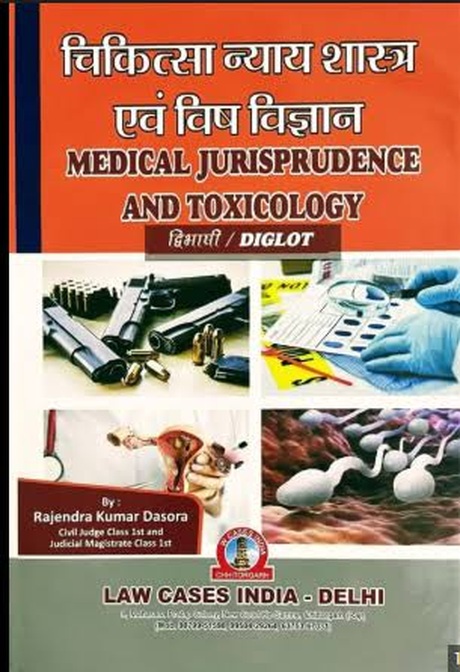
| चिकित्सा न्याय शास्त्र एवं विष विज्ञान / Medical Jurisprudence and Toxicology by Rajendra Kumar Dasora, Civil Judge Class I and Judicial Magistrate Class I, published by Law Cases India, Delhi, is a diglot (द्विभाषी) volume carrying the text in both Hindi and English. It covers the medical witness and the proof of medical records, identification by race, sex, age, dentition, fingerprints and DNA, the signs of death and the estimation of time since death through rigor mortis, livor mortis and algor mortis, inquest and post mortem examination, mechanical and firearm injuries and the distinction between ante-mortem and post-mortem injuries, asphyxial deaths by hanging, strangulation and drowning, burns and dowry death, medical examination in sexual offences, abortion and infanticide, forensic psychiatry and criminal responsibility, and toxicology — the classification of poisons, collection of viscera and the chemical analyser's report, corrosives and metallic irritants, opium, alcohol, dhatura and narcotic drugs, aluminium phosphide and organophosphorus pesticides, and snake bite. Hardbound, Hindi and English. |


Tags: Evidence Law, Forensic Science, Medical jurisprudence, Medical Evidence
चिकित्सा न्याय शास्त्र एवं विष विज्ञान / Medical Jurisprudence and Toxicology — द्विभाषी (Diglot) संस्करण — by Rajendra Kumar Dasora, Civil Judge Class I and Judicial Magistrate Class I, published by Law Cases India, Delhi. Hardbound, Hindi and English in one volume.
Medical evidence decides more criminal trials than any other single class of proof. Whether the injury was ante-mortem or post-mortem, how long the deceased had been dead, whether the weapon recovered could have caused the wound, whether the poison detected is consistent with the manner of death alleged — these are the questions on which a sessions case turns, and they are answered in the vocabulary of medicine by a witness the lawyer must then cross-examine.
The difficulty for the Indian practitioner is that the standard works on forensic medicine are written for doctors, and almost entirely in English, while a great deal of trial work in the Hindi-speaking States is conducted in Hindi. This book is built for exactly that gap. It is a diglot — the text runs in both Hindi and English — and it is written by a serving judicial officer rather than a clinician, so the emphasis falls on what a court needs to decide rather than on clinical management.
Key Features / विशेषताएँ
- Diglot (द्विभाषी) edition — the text in Hindi and English together
- Written by Rajendra Kumar Dasora, Civil Judge Class I and Judicial Magistrate Class I
- Covers medical jurisprudence and toxicology in a single volume
- Oriented to the courtroom — proof, appreciation and cross-examination of medical evidence
- Useful on both sides of the record and on the Bench
- Hardbound · approx. 924 pages · Law Cases India, Delhi
Coverage / विषय-वस्तु
Medical Jurisprudence: Foundations. The scope of medical jurisprudence and its place in the administration of justice; the medical witness, the expert and the opinion he may give; medical records and their proof; and professional duties, consent and confidentiality.
Identification. Establishment of identity — race, sex, age, stature and dentition; age determination from bones and teeth, and its importance in juvenile and sexual offence cases; scars, tattoos and anthropometry; fingerprints and DNA profiling; and identification of the dead and of skeletal remains.
Death and Its Signs. The legal and medical concept of death, brain death, the signs of death and the changes after it — rigor mortis, livor mortis, algor mortis, putrefaction, adipocere and mummification — and the estimation of time since death.
Post Mortem Examination. Inquest, the conduct of an autopsy and the contents of the report, exhumation and second autopsy, and the evidentiary value of post-mortem findings.
Injuries. Mechanical injuries and their classification; abrasions, contusions, lacerations, incised and stab wounds; firearm injuries, range and direction; ante-mortem and post-mortem injuries; the age of injuries; and the correlation of injury with the weapon alleged, together with the statutory classification of hurt and grievous hurt.
Asphyxial Deaths. Hanging, strangulation, throttling, suffocation and drowning — the findings in each and the distinctions the court is asked to draw, including suicidal, homicidal and accidental manner of death.
Thermal, Electrical and Other Deaths. Burns and scalds, dowry and bride-burning cases, death by cold, lightning and electrocution, and starvation.
Sexual Offences and Reproduction. Medical examination of the victim and of the accused in cases of rape and allied offences; virginity and pregnancy; abortion and the Medical Termination of Pregnancy Act; infanticide and the signs of live birth; impotence and sterility; and legitimacy.
Forensic Psychiatry. Mental illness and criminal responsibility, the defence of unsoundness of mind, civil capacity, and the examination of the accused.
Toxicology: General Principles. The definition and classification of poisons, the diagnosis of poisoning in the living and the dead, the duties of the medical officer, the collection and despatch of viscera, and the chemical analyser's report and its evidentiary value.
Corrosive and Irritant Poisons. Mineral acids and alkalis; metallic irritants including arsenic, mercury, lead and copper; and vegetable and animal irritants.
Neurotic and Organic Poisons. Opium and morphine, barbiturates and sedatives, alcohol and its medico-legal aspects, dhatura, strychnine (nux vomica), cannabis, cocaine and the narcotic drugs; and deliriant poisons.
Agricultural and Household Poisons. Organophosphorus and other pesticides, aluminium phosphide, kerosene and household chemicals — the poisons most often met in Indian practice.
Asphyxiants and Animal Poisons. Carbon monoxide and other gases; snake bite, scorpion sting and other animal poisons.
Who Should Buy This Book? / यह पुस्तक किनके लिए है?
- Criminal advocates on both sides of the record, especially in sessions trials
- Public prosecutors and law officers
- Judicial officers, and candidates for the judicial service and APO examinations
- Police and investigating officers, and police training academies
- Medical officers and forensic experts who depose in court
- LL.B., LL.M. and forensic science students
- Practitioners in the Hindi-speaking States who need the subject in both languages
- Law college, medical college and court libraries
Why Choose This Book? / यह पुस्तक क्यों?
The diglot format is the whole argument. A lawyer in a Madhya Pradesh, Rajasthan or Uttar Pradesh sessions court argues in Hindi but must read a post-mortem report and a chemical analyser's report written in English. Having the terminology in both languages, side by side, is a practical advantage no single-language text can offer.
The second reason is the author's vantage point. Dasora is a serving Civil Judge and Judicial Magistrate, not a clinician. The book therefore treats the subject as a judge encounters it — what the finding proves, what it does not, and where the defence can legitimately press.
The third is scope. Medical jurisprudence and toxicology are usually sold as separate volumes. Having both, with the Indian poisons that actually appear in trials — aluminium phosphide, organophosphorus pesticides, dhatura, snake bite — treated alongside the injury and asphyxia material, makes this a single reference for the whole of medical evidence.