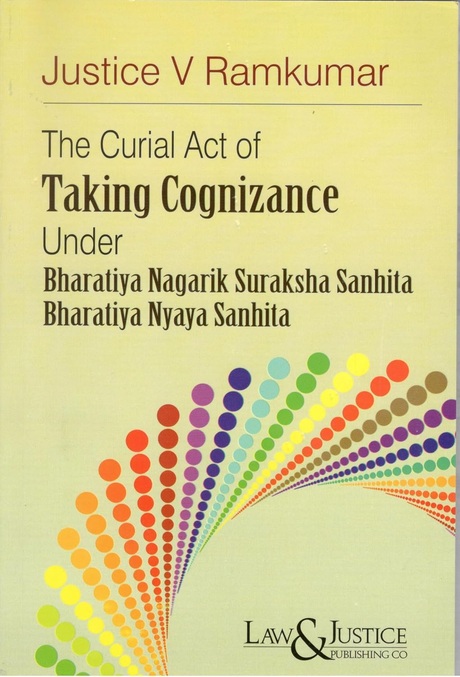
Law & Justice's The Curial Act of Taking Cognizance under BNSS & BNS - Edtion 2027
| Author : | Justice V Ramkumar |
|---|
| Law & Justice Publishing Co.'s The Curial Act of Taking Cognizance under the Bharatiya Nagarik Suraksha Sanhita and the Bharatiya Nyaya Sanhita, by Justice V. Ramkumar, former Judge of the High Court of Kerala, is a focused monograph on one of the most misunderstood steps in Indian criminal procedure. It explains what taking cognizance means as a curial act and how it differs from a cognizable offence, the modes of taking cognizance on a complaint, on a police report and on information or the Magistrate's own knowledge, who may take cognizance and when, the acts that do and do not amount to it, the bars and conditions precedent including sanction and limitation, cognizance in the special categories, and what follows - examination of the complainant, inquiry, process against the accused and framing of charge - all carried across to the new statutes, where Section 190 CrPC now sits in Section 210 BNSS. For criminal law practitioners, magistrates and judicial officers, prosecutors, judicial service aspirants and students. |


Tags: Bharatiya Nyaya Sanhita (BNS), Bharatiya Nagarik Suraksha Sanhita(BNSS), Code Of Criminal Procedure, Criminal Trial
Justice V. Ramkumar's The Curial Act of Taking Cognizance under the Bharatiya Nagarik Suraksha Sanhita and the Bharatiya Nyaya Sanhita Edtion 2027
Law & Justice Publishing Co. publishes The Curial Act of Taking Cognizance by Justice V. Ramkumar, former Judge of the High Court of Kerala — a focused monograph on one of the most misunderstood steps in Indian criminal procedure, worked through under the Bharatiya Nagarik Suraksha Sanhita, 2023 and the Bharatiya Nyaya Sanhita, 2023.
Why a whole book on taking cognizance
"Taking cognizance" is nowhere defined in the statute, and almost every criminal case turns on it at some point. Whether a Magistrate has taken cognizance, when he took it, whether he could take it at all, and what follows once he has, decide the fate of applications, revisions and appeals every day in every criminal court in India. The confusion is long-standing — most commonly the conflation of a "cognizable offence" with "the curial act of taking cognizance of an offence", two wholly different things that share a word.
Justice Ramkumar, whose writing on criminal procedure is widely followed by the profession, treats the subject as what it is: a judicial act with its own conditions, its own moment, and its own consequences. The analysis is carried across to the new statutes, where the provision formerly found in Section 190 CrPC now sits in Section 210 BNSS, with the attendant changes in numbering and language throughout.
What the book deals with
- What "taking cognizance" means as a curial act, and the distinction between it and a cognizable offence.
- The modes of taking cognizance — on a complaint, on a police report, and on information received from any person other than a police officer or upon the Magistrate's own knowledge.
- Who may take cognizance, and the limits of a Magistrate's and a Court of Session's competence to do so.
- When cognizance is taken, and the acts that do and do not amount to it — the question on which so many revisions turn.
- Bars and conditions precedent — sanction, limitation and the statutory bars on cognizance.
- Cognizance of offences against the State, of contempt, of offences by public servants and the other special categories.
- What follows cognizance — examination of the complainant, inquiry, process against the accused, and the road to framing of charge.
- The corresponding provisions under the BNSS and the BNS, set against the Code of Criminal Procedure, 1973 and the Indian Penal Code, 1860 that they replace.
Who should buy this book
- Criminal law practitioners arguing on cognizance, sanction, limitation and the validity of process.
- Magistrates, Sessions Judges and judicial officers who take cognizance as part of daily work under the new Sanhitas.
- Public prosecutors and investigating agencies.
- Judicial service aspirants, for whom cognizance is a standing examination topic now examined under the BNSS.
- Law students and academics reading criminal procedure under the new codes.
About the author
Justice V. Ramkumar is a former Judge of the High Court of Kerala and a prolific writer on criminal law and procedure, widely published on the Bharatiya Nagarik Suraksha Sanhita and the new criminal statutes. He is also the author of Confessions in Criminal Trial from the same publisher.