Puri's Compendium on RTI Law & Practice - Practical Handbook on Right to Information Act, 2005 - Edition 2027
| Author : | V.K. Puri |
|---|
| A practical compendium on the Right to Information Act, 2005 as amended up to September 2026, written for information seekers, Public Information Officers and First Appellate Authorities, and carrying the commentary together with the Act, the Rules, notifications, circulars, State Rules, the prescribed manuals and the forms and registers an office has to maintain. Coverage runs through the definitions of information, public authority and record, the Section 4 proactive disclosure obligations, the making and disposal of a request with time limits and deemed refusal, every clause of the Section 8 exemptions including personal information under Section 8(1)(j) as it now stands after the Digital Personal Data Protection Act, 2023, the public interest override, severability, third party information under Section 11, the constitution and powers of the Central and State Information Commissions, first and second appeals with the burden of proof on the PIO, penalties under Section 20, and the Section 24 exclusions. Decisions of the Central Information Commission, the High Courts and the Supreme Court are given throughout, and the Digital Personal Data Protection Act, 2023 and DPDP Rules, 2025 are included. 2027 Edition, A Puri Publication. |


Tags: Governance, Risk Management, Compliances And Ethics, Administrative Law, Right to Information Law, Digital Data Protection
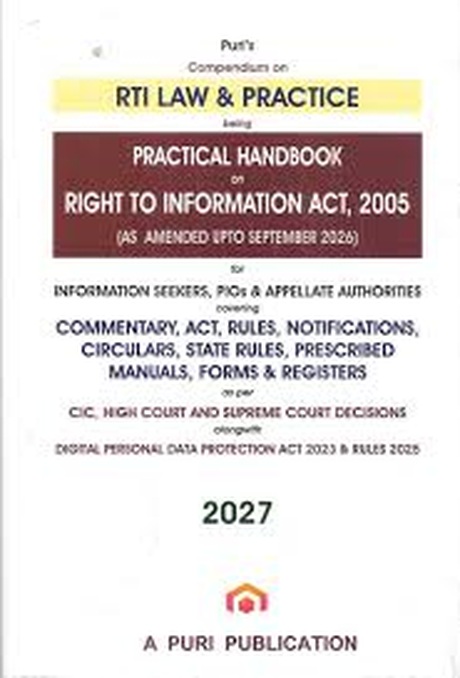
Puri's Compendium on RTI Law & Practice, being a Practical Handbook on the Right to Information Act, 2005 as amended up to September 2026, by V. K. Puri, published by A Puri Publication. 2027 Edition.
The Right to Information Act is a short statute that generates an enormous amount of day-to-day work, and the people who do that work are rarely lawyers. A Public Information Officer deciding whether an exemption applies, a First Appellate Authority hearing an appeal, an applicant drafting a request that will not be rejected on form — each needs the same three things: the provision, the decisions interpreting it, and the prescribed form. This compendium is built around that need rather than around the structure of a commentary.
It is addressed on its face to information seekers, PIOs and Appellate Authorities, and it carries the commentary together with the Act, the Rules, notifications, circulars, State Rules, the prescribed manuals, and the forms and registers that an office actually has to maintain. Decisions of the Central Information Commission, the High Courts and the Supreme Court are included, which matters because a very large part of practical RTI law is CIC decision-making that is never reported in the law journals.
This edition also carries the Digital Personal Data Protection Act, 2023 and the Rules, 2025. That is a deliberate and useful pairing: the DPDP Act amended Section 8(1)(j) of the RTI Act, which is the personal-information exemption and the single most frequently invoked ground of refusal. The two statutes now have to be read together, and a PIO applying Section 8(1)(j) from an older book is applying a provision that has been substituted.
Key Features
- Amended up to September 2026 — the current text of the Act and Rules.
- Includes the Digital Personal Data Protection Act, 2023 and the DPDP Rules, 2025, which bear directly on the Section 8(1)(j) exemption.
- Written for information seekers, PIOs and First Appellate Authorities alike, rather than for litigators only.
- Commentary with the bare Act and Rules in a single volume.
- Notifications, circulars and State Rules collected together — the material that is otherwise scattered across department websites.
- Prescribed manuals, forms and registers for office use and for Section 4 proactive disclosure compliance.
- Decisions of the Central Information Commission, the High Courts and the Supreme Court.
- 2027 Edition, from A Puri Publication, by V. K. Puri.
Coverage
- The Right to Information Act, 2005 in full, as amended, with section-wise commentary.
- Definitions — "information", "right to information", "public authority", "record" and "third party", and the litigation each has generated.
- Section 4 — proactive disclosure: the obligations of every public authority, the suo motu publication requirements, and the manuals prescribed for compliance.
- Making a request: Section 6, the form of the application, fees, transfer of an application to another public authority, and the limits on asking for reasons.
- Disposal of a request — Section 7: time limits, deemed refusal, fees for providing information, partial disclosure and the rejection order.
- Exemptions from disclosure — Section 8: each clause, including sovereignty and integrity, parliamentary privilege, commercial confidence and trade secrets, fiduciary relationship, foreign government information, safety of persons, investigation and prosecution, cabinet papers, and personal information under Section 8(1)(j) as it now stands after the DPDP Act, 2023.
- The public interest override, and how the Commissions and courts have applied it.
- Section 9 grounds for rejection, and Section 10 severability.
- Third party information — Section 11 and the procedure before disclosure.
- The Information Commissions: constitution, powers and functions of the Central and State Information Commissions, and the position after the 2019 amendment.
- Appeals — Section 19: first appeal to the First Appellate Authority, second appeal to the Commission, limitation, the burden of proof on the PIO, and judicial review.
- Penalties — Section 20: the penalty on the PIO, disciplinary action, and when a Commission will impose it.
- Organisations excluded under Section 24 and the Second Schedule, and the allegations of corruption and human rights violations proviso.
- The RTI Rules and the State RTI Rules, with fee schedules.
- Notifications and circulars of the DoPT and the Commissions.
- Forms and registers for applications, appeals, receipts and office records.
- The Digital Personal Data Protection Act, 2023 and the DPDP Rules, 2025, and their interaction with the RTI regime.
- Decisions of the CIC, the High Courts and the Supreme Court throughout.
Who Should Buy This Book?
- Public Information Officers and Assistant PIOs in Central and State public authorities — the primary readership.
- First Appellate Authorities deciding appeals under Section 19(1).
- Information Commissioners and Commission staff.
- RTI applicants and activists, and the organisations that support them.
- Advocates in RTI second appeals, writ petitions and penalty proceedings.
- Government departments, PSUs, banks, universities and local bodies maintaining RTI compliance and Section 4 disclosures.
- Compliance and data protection officers who must now reconcile RTI obligations with the DPDP Act, 2023.
- Company secretaries and governance professionals, where RTI features on the syllabus.
- Journalists and researchers using RTI as a working tool.
- Law college, government department and institutional libraries.
Why Choose This Book?
Most RTI books are one of two kinds: a thin bare-act-plus-notes volume for applicants, or an academic commentary for advocates. The person actually deciding most RTI matters in India is a PIO or a First Appellate Authority who is a departmental officer, not a lawyer, and who needs to apply an exemption correctly on a file today. A compendium that carries the commentary, the CIC decisions, the State Rules and the prescribed forms in one volume is aimed squarely at that reader, and that is an underserved market.
The decisive feature of this edition is the inclusion of the Digital Personal Data Protection Act, 2023 and its Rules, 2025. The DPDP Act amended the personal-information exemption in Section 8(1)(j), which is cited in a very large share of all refusals. Any book that predates it states that exemption in a form that no longer exists — and a refusal grounded on the superseded wording is a refusal waiting to be set aside on appeal. Currency to September 2026 is the reason to buy this edition rather than a cheaper older one.