Law & Justice's Textbook on The Transfer of Property by Anjay Kumar Sharma
| Author : | Anjay Kumar Sharma |
|---|
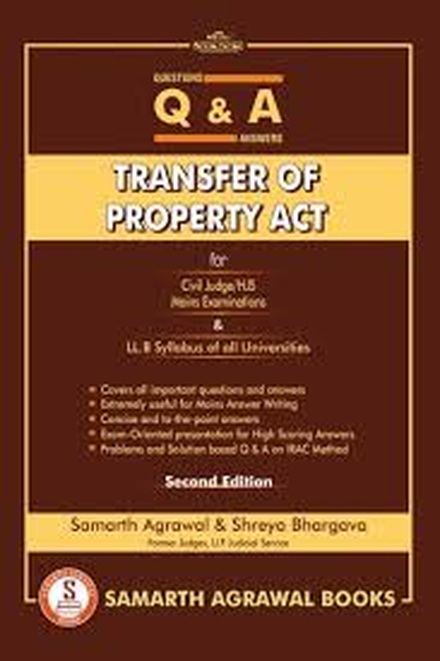
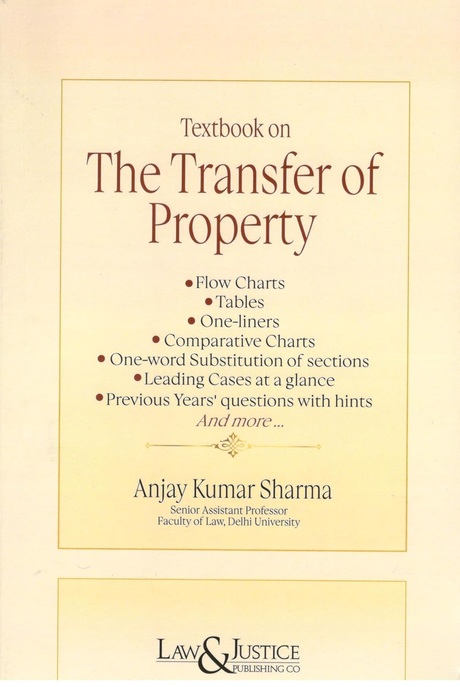
| Law & Justice Publishing Co.'s Textbook on The Transfer of Property by Anjay Kumar Sharma, Senior Assistant Professor at the Faculty of Law, University of Delhi, is a student and examination text on the Transfer of Property Act, 1882, built around flow charts, tables, one-liners, comparative charts, one-word substitution of sections, leading cases at a glance and previous years' questions with hints. It covers the scope of the Act and the meaning of transfer of property, transfers by act of parties, the rule against perpetuities, vested and contingent interests, conditional transfers and election, the doctrines of lis pendens, fraudulent transfer, part performance, feeding the grant by estoppel and transfer by ostensible owner, sales of immovable property, mortgages and charges with redemption, foreclosure, priority, subrogation and marshalling, leases and the distinction from licences, and exchanges, gifts and actionable claims. For LL.B. students, judicial service and AIBE aspirants, young advocates and teaching faculty. |

English

Tags: ACADEMIC LAW BOOKS, Property Law, Transfer of Property Act, Civil Judge ( J.D. ) and H.J.S.
Law & Justice's Textbook on The Transfer of Property by Anjay Kumar Sharma
Law & Justice Publishing Co. publishes Textbook on The Transfer of Property by Anjay Kumar Sharma, Senior Assistant Professor, Faculty of Law, University of Delhi — a student and examination text on the Transfer of Property Act, 1882, built around the visual devices that make a dense statute learnable.
The Transfer of Property Act is one of the hardest papers in the LL.B. course for a particular reason: the sections are short, abstract and heavily cross-referenced, and the difference between a sale, an exchange, a gift, a lease, a licence, a mortgage and a charge turns on distinctions a student has to hold in mind all at once. This book is written to that problem — it is organised to be compared, charted and revised rather than read straight through.
What the book gives you
- Flow charts — the operation of a provision set out as a sequence of steps and branches, so the conditions and exceptions are visible at once.
- Tables summarising the provisions and their requirements.
- One-liners — the proposition of each section reduced to a single sentence for last-minute revision.
- Comparative charts — sale against exchange, lease against licence, mortgage against charge, gift against will, and the other distinctions examiners return to every year.
- One-word substitution of sections — a label for each section, which is how section numbers are actually remembered under exam pressure.
- Leading cases at a glance — the authorities that must be cited, with their propositions.
- Previous years' questions with hints — past university and competitive examination questions, with guidance on how to approach each.
Subject matter covered
- Scope of the Act, movable and immovable property, and the meaning of "transfer of property".
- Transfers of property by act of parties — who may transfer, what may be transferred, and the conditions attached.
- The rule against perpetuities, vested and contingent interests, conditional transfers and the doctrine of election.
- Doctrines — lis pendens, fraudulent transfer, part performance, feeding the grant by estoppel, and the transfer by ostensible owner.
- Sales of immovable property — rights and liabilities of buyer and seller, and the marshalling of securities.
- Mortgages and charges — the kinds of mortgage, redemption and foreclosure, priority, subrogation and marshalling.
- Leases — creation, duration, rights and liabilities of lessor and lessee, determination and holding over, and the distinction from a licence.
- Exchanges, gifts and actionable claims.
Who should buy this book
- LL.B. and B.A. LL.B. students taking Property Law or Transfer of Property as a paper — written by a Delhi University faculty member to that syllabus.
- Judicial service aspirants preparing for Civil Judge (PCS-J) and Higher Judicial Service examinations, where the Act is a standing part of the civil law paper.
- Candidates for AIBE and other law competitive examinations.
- Young advocates who want the distinctions and leading cases in one compact place before a property matter.
- Teachers and coaching faculty looking for charts and comparative material to use in class.