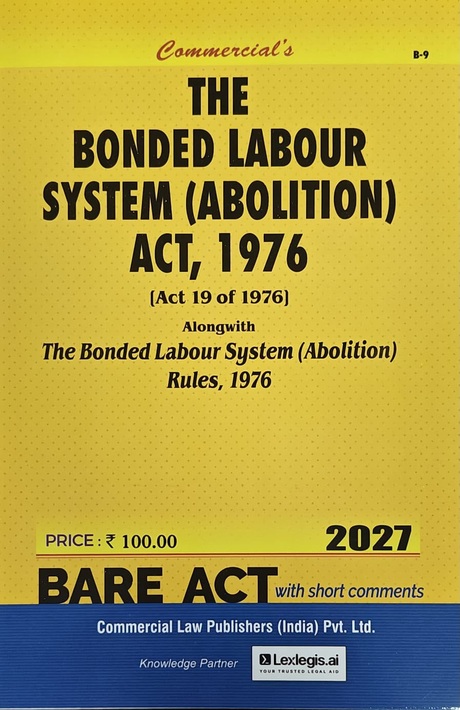
Commercial's The Bonded Labour System (Abolition) Act, 1976 with Rules - Bare Act with Short Comments - Edition 2027
| Author : | Bare Act |
|---|
| The Bonded Labour System (Abolition) Act, 1976 (Act 19 of 1976) together with the Bonded Labour System (Abolition) Rules, 1976, as a bare act with short comments. The Act abolishes the bonded labour system outright: every bonded labourer stands released and discharged from any obligation to render bonded labour, every bonded debt is extinguished by operation of law so that no suit or proceeding lies for its recovery and existing attachments stand vacated, property taken from a bonded labourer is restored, and eviction from homestead premises is barred. Coverage includes the definitions of bonded labour, bonded labourer, bonded debt, advance and nominal wages, the duties of the District Magistrate as implementing authority, the constitution, composition and functions of the Vigilance Committees at district and sub-divisional level and their rehabilitation duty, the offences of enforcing bonded labour, advancing a bonded debt and extracting bonded labour, offences by companies, the summary trial of offences by an Executive Magistrate and the burden of proof, together with the Rules governing the Committees, the procedure for restoration of property and the prescribed forms and registers. 2027 Edition, Commercial Law Publishers (India) Pvt. Ltd. |


Tags: Labour Law, BARE ACT, Labour And Industrial Laws, The Bonded Labour Sytem ( Abolotion)Act
Commercial's The Bonded Labour System (Abolition) Act, 1976 (Act 19 of 1976), together with The Bonded Labour System (Abolition) Rules, 1976 — Bare Act with short comments, published by Commercial Law Publishers (India) Pvt. Ltd. 2027 Edition.
The Bonded Labour System (Abolition) Act, 1976 is a short statute with an unusually wide reach. It does not merely prohibit bonded labour; it abolishes the system outright, extinguishes every bonded debt by operation of law, frees every bonded labourer from the date of commencement, and makes the enforcement of such a debt a criminal offence. It also restores property taken from a bonded labourer and bars eviction from homestead land. Few Indian statutes operate so directly on existing private obligations.
In practice the Act works through the machinery in the Rules: the District Magistrate as the implementing authority, and the Vigilance Committees constituted at district and sub-divisional level, which are charged with identification, release and rehabilitation. This volume carries both the Act and the Bonded Labour System (Abolition) Rules, 1976, which is the combination a field officer or a lawyer actually needs — the Act alone states the right, and the Rules alone tell you how it is enforced.
Key Features
- The full text of the Bonded Labour System (Abolition) Act, 1976 (Act 19 of 1976).
- The Bonded Labour System (Abolition) Rules, 1976 included — the implementing machinery, with the prescribed forms and registers.
- Short comments alongside the bare text, in the Commercial's bare act format.
- 2027 Edition, from Commercial Law Publishers (India) Pvt. Ltd., with Lexlegis.ai as knowledge partner.
- Act and Rules in one volume at ₹100 — practical for distribution to field staff, committee members and legal aid workers.
Coverage
The Bonded Labour System (Abolition) Act, 1976
- Definitions — "bonded labour", "bonded labourer", "bonded debt", "advance", "nominal wages", "ascendant or descendant" and "family", and the several forms the bonded labour system takes.
- Abolition of the bonded labour system — the release and discharge of every bonded labourer from any obligation to render bonded labour, by force of the statute itself.
- Extinguishment of liability to repay bonded debt — the obligation to repay is extinguished, no suit or proceeding lies for its recovery, and any attachment or decree already made stands vacated.
- Restoration of property to the bonded labourer, and the procedure before the prescribed authority.
- Freedom of residence and the bar on eviction from homestead or other residential premises.
- Creditor not to accept payment against an extinguished debt.
- Implementing authorities — the District Magistrate and the officers he may specify, and their duty to promote the welfare of freed bonded labourers.
- Vigilance Committees — their constitution at district and sub-divisional level, composition, functions and the duty of economic and social rehabilitation.
- Offences and penalties — enforcing bonded labour, advancing a bonded debt, extracting bonded labour under the system, omission or failure to restore possession, and the abetment of these offences.
- Offences by companies, and the liability of officers.
- Trial of offences — cognizance, the power of an Executive Magistrate to try offences summarily, and the provisions on burden of proof.
- Protection of action taken in good faith, the rule-making power, and the repeal of corresponding earlier laws.
The Bonded Labour System (Abolition) Rules, 1976
- Constitution of Vigilance Committees — the manner of nomination, terms of office and procedure for meetings.
- Functions and powers of the Committees in identification, release, rehabilitation and the defence of suits against freed labourers.
- Procedure before the prescribed authority for restoration of property.
- Forms and registers prescribed under the Act.
Who Should Buy This Book?
- District Magistrates, Sub-Divisional Magistrates and Executive Magistrates charged with implementing the Act.
- Members and secretaries of Vigilance Committees at district and sub-divisional level.
- Labour department officers and labour inspectors.
- Legal aid lawyers, NGOs and civil society organisations working on bonded labour, forced labour and trafficking.
- Advocates in release, rehabilitation and compensation matters, and in public interest litigation on forced labour.
- Police officers and prosecutors dealing with offences under the Act.
- LL.B. and LL.M. students of Labour Law, Human Rights and Constitutional Law — the Act is the statutory expression of Article 23.
- Judicial service aspirants, and students of social work and public administration.
- Employers and compliance teams in agriculture, brick kilns, quarrying, construction and other sectors where the risk arises.
Why Choose This Book?
The practical merit of this volume is that it carries the Rules with the Act. The Act declares rights that operate automatically — the labourer is freed, the debt is extinguished — but the work of identifying who is covered, securing release and arranging rehabilitation happens through the District Magistrate and the Vigilance Committees, and that is governed by the Rules. A copy of the Act alone leaves the reader with the principle and none of the procedure.
The other reason is price and portability. This is legislation that is applied in the field by officers, committee members and NGO workers rather than argued over in appellate courts, and a ₹100 volume is something an organisation can buy in quantity and actually hand out. For a law that gives effect to the Article 23 prohibition on traffic in human beings and forced labour, that matters more than it would for a commercial statute.