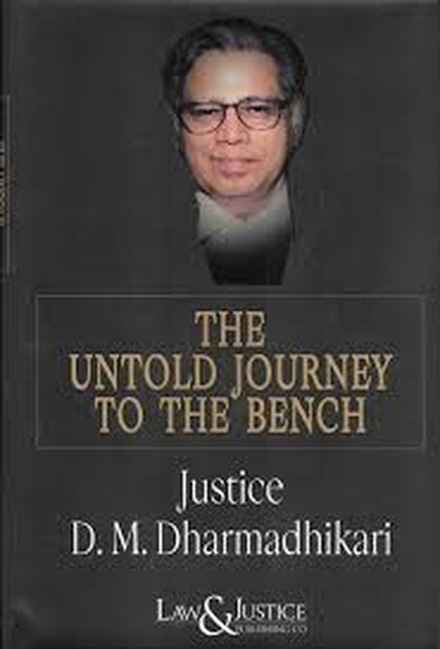
L&J's The Untold Journey to the Bench - Edition 2026
| Author : | Justice D. M. Dharmadhikari |
|---|
| The Untold Journey to the Bench by Justice D. M. Dharmadhikari, former Judge of the Supreme Court of India, published by Law & Justice Publishing Co., is a judicial memoir tracing a career that began in 1966 at Betul alongside the author's father, moved to Jabalpur, led to the Madhya Pradesh High Court in 1989, to the office of Chief Justice of the Gujarat High Court in 2000, and to the Supreme Court of India from 2002 to 2005. More than an autobiography, it reflects on the values, ethics, spirituality and judicial philosophy that shaped the author's work, drawing throughout on the influence of his father, the Gandhian thinker Dada Dharmadhikari, and exploring the relationship between law, morality, justice, public service and spirituality, together with judicial ethics, constitutional values, professional integrity and the responsibilities of those entrusted with the administration of justice. An enriching read for judges, advocates, law students, judicial service aspirants, academicians and anyone interested in the human side of the legal profession. English, ISBN 9788169453332. |


Tags: Public Interest Lawyering, Indian Legal And Constitutional History, Legal Ethics, Professional Ethics
The Untold Journey to the Bench by Justice D. M. Dharmadhikari, former Judge of the Supreme Court of India, published by Law & Justice Publishing Co., is a judicial memoir — an account of a career that ran from a district court in Betul to the highest court in the country, and of the values that carried it there. Edition 2026, English.
Justice Dharmadhikari was born at Nagpur in 1940 and began practice in 1966 at Betul, alongside his father, before moving to Jabalpur and building an independent practice there. He was appointed an Additional Judge of the Madhya Pradesh High Court in 1989 and a permanent Judge in 1990, became Chief Justice of the Gujarat High Court in January 2000, and was elevated to the Supreme Court of India in March 2002, where he sat until his retirement in August 2005.
The book is not a list of those appointments. It is a reflection on what the work asked of him, and on where the answers came from — most of all from his father, the Gandhian thinker Dada Dharmadhikari, whose influence runs through the whole account. The questions it returns to are the ones a judge cannot avoid for long: what the relationship is between law and morality, what justice requires beyond what the statute says, what a public office does to the person holding it, and what place spirituality has in a life spent deciding other people's disputes.
Indian legal writing has very few books of this kind. Judgments are public and judges are not, and a first-hand account of how the Bench actually looks from the inside — written without score-settling and with an unusual willingness to examine the author's own doubts — is rare enough to be worth having for that alone.
Key Features
- A judicial memoir by a former Judge of the Supreme Court of India
- Published by Law & Justice Publishing Co., Edition 2026
- Traces the journey from the Bar to the Bench — district practice to the Supreme Court
- Reflections on judicial ethics, constitutional values and professional integrity
- The influence of Dada Dharmadhikari and the Gandhian tradition on the author's judicial outlook
- Explores the relationship between law, morality, justice, public service and spirituality
- Written for the general reader as much as the lawyer · English · ISBN 9788169453332
What the Book Covers
Early Life and Formation. Birth and upbringing at Nagpur, education, the decision to read law, and the household in which the author's ideas about duty and public service were formed.
The Influence of Dada Dharmadhikari. The author's father, a Gandhian thinker of standing, and the moral vocabulary the author inherited from him — the part of the book that explains the rest of it.
At the Bar. Beginning practice at Betul in 1966 with his father, the move to Jabalpur, the slow construction of an independent practice, and what the early years at the Bar teach that nothing else does.
Elevation to the Bench. Appointment to the Madhya Pradesh High Court, the adjustment from advocate to judge, and the loneliness of the office.
Chief Justice of the Gujarat High Court. The administrative side of judicial life — running a High Court, the responsibilities that have nothing to do with deciding cases, and institutional leadership.
The Supreme Court. The years on the highest court, the weight of constitutional adjudication, and the discipline of deciding questions whose answers bind the whole country.
Judicial Ethics and Integrity. The standards a judge is held to and the ones he holds himself to, independence, the pressures brought to bear, and the conduct that preserves — or forfeits — public confidence.
Law, Morality and Justice. The gap between legality and justice, the role of conscience in adjudication, and what a judge does when the two point in different directions.
Spirituality and Public Life. The author's reflections on the inner life of a person in high office, and on what sustains judgment over a long career.
To the Next Generation. What the author would say to young advocates, judicial service aspirants and newly appointed judges about the work they are taking on.
Who Should Buy This Book?
- Judges at every level, and newly appointed judicial officers
- Advocates, particularly those early in practice
- Judicial service aspirants preparing for the interview and for the career beyond it
- LL.B. and LL.M. students, and teachers of legal ethics and the legal profession
- Judicial academies and training institutes
- Readers interested in Gandhian thought and its application to public office
- Anyone drawn to memoirs of Indian public life and the human side of the legal profession
- Law college, court and institutional libraries
Why Choose This Book?
Courses on professional ethics teach the rules. This book shows what it is like to live inside them — which is a different and more useful thing. A young advocate learns more about judicial temperament from one honest account of a judge's doubts than from a chapter of the Bar Council rules.
The second reason is the Gandhian thread. Few Indian judges have written about the moral sources of their judging, and fewer still from inside that particular tradition. The influence of Dada Dharmadhikari makes this more than a career memoir: it is an argument about where a judge's standards should come from.
The third is readability. There is no apparatus, no citation, nothing that requires a legal training to follow. It can be read by a law student in a weekend, given to a colleague on elevation, or read by anyone who simply wants to know what the journey to the Bench actually involves.